


This is the NRI side-account mistake. And it is costing thousands of non-resident Indians not just money, but peace of mind, tax compliance, and in some cases, legal standing.
Managing India money from afar is not just an inconvenience — it is a structural problem that requires a structural solution. This blog breaks down exactly why it fails, where the mistakes happen, and what a sound NRI financial plan looks like instead.
Why the “I’ll Handle It Later” Approach Breaks Down
The moment you become an NRI — technically, when you spend fewer than 182 days in India in a financial year — your financial obligations in India do not pause. They transform.
Your resident savings account must be converted. Your investment folios need updated KYC. Your tax filing status changes. Your bank may continue sending you SMS alerts, giving you the illusion of control. But behind the scenes, the compliance clock is ticking.
Most NRIs discover the problem only when they try to repatriate money, sell a property, or return to India. By then, the tangle of non-compliant accounts, outdated nominations, and undeclared income has grown into something that requires a chartered accountant, a lawyer, and months of paperwork to unwind.
Let’s go through the specific failure points — one by one.
Mistake 1 — Keeping a Resident Savings Account After Becoming an NRI
This is the most common and most misunderstood mistake in NRI financial management in India.
Under FEMA (Foreign Exchange Management Act), the moment your residential status changes to NRI, you are legally required to convert your existing resident savings account into either an NRO (Non-Resident Ordinary) or NRE (Non-Resident External) account. Continuing to operate a resident savings account as an NRI is a violation of FEMA regulations.
What actually happens?
Most NRIs don’t convert. They continue using their old account, receiving income into it, even operating UPI payments through it. Banks don’t always flag this proactively. So it continues for years.
The risk: if this comes up during a property sale, a tax assessment, or a repatriation request, you may face questions about the source and legality of funds that have been sitting in a non-compliant account.
NRO vs NRE — The Distinction That Matters
This is where confusion compounds the original mistake. Many NRIs open “an NRI account” without understanding that NRO and NRE serve fundamentally different purposes.
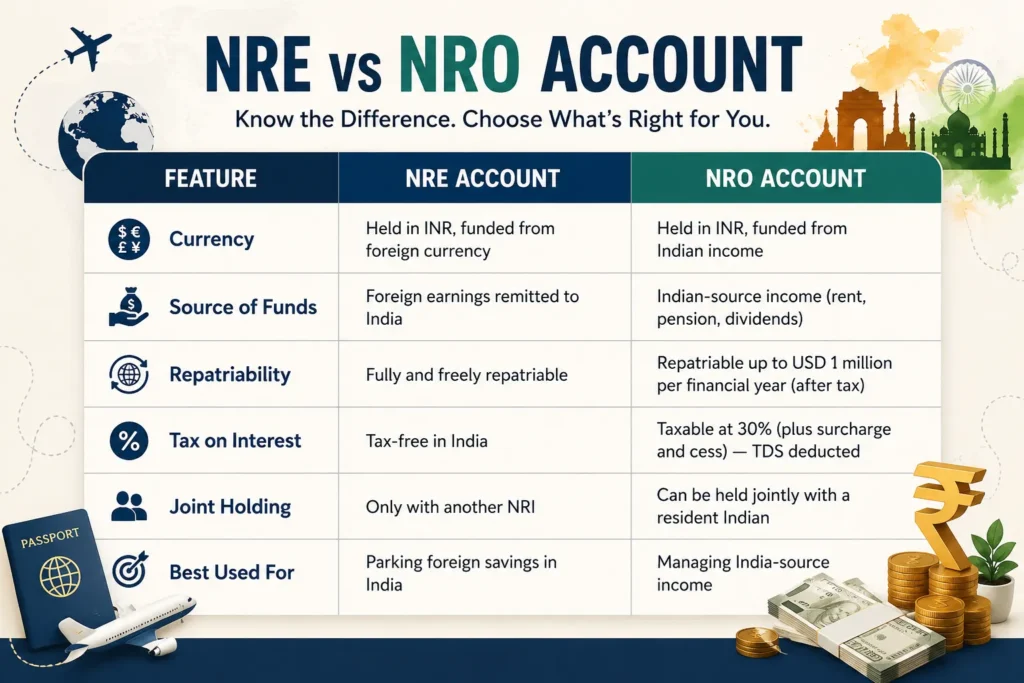
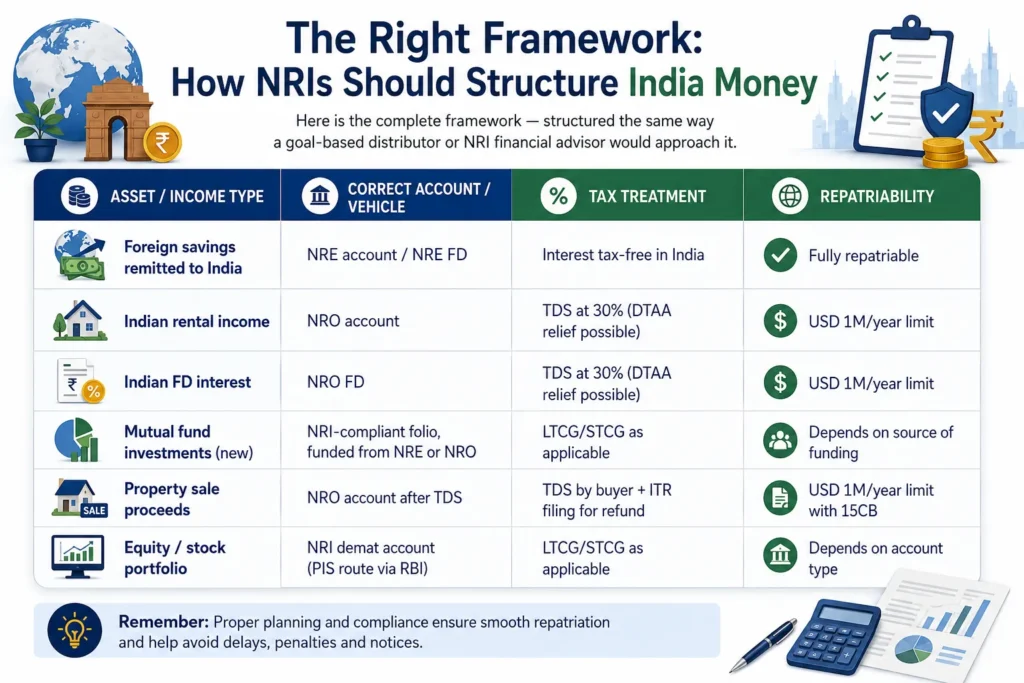
A common misunderstanding is treating the NRE account as a one-stop solution for all banking needs in India. While it is ideal for parking foreign earnings, income that originates in India such as rent, pension, or dividends belongs in an NRO account. Failing to separate the two can create avoidable compliance issues.
Another area where NRIs are often caught off guard is taxation. Interest earned on an NRO account is not tax-free. Banks deduct TDS at 30% (plus surcharge and cess) before crediting the interest. Depending on your country of residence, DTAA benefits may reduce the overall tax burden, but only if the necessary procedures are followed.
Mistake 2 — Ignoring the Tax Filing Obligation in India
“I don’t earn in India, so I don’t need to file a return.”
This is one of the most dangerous assumptions an NRI can make.
When is an NRI required to file an Indian tax return?
You are required to file an Indian income tax return if your India-sourced income exceeds the basic exemption limit (currently ₹2.5 lakh under the old regime, or ₹3 lakh under the new regime, subject to changes announced in the Union Budget). India-sourced income for NRIs includes:
- Rental income from property in India
- Interest on NRO fixed deposits and savings accounts
- Capital gains from sale of property, equity, or mutual funds in India
- Dividends from Indian companies (above the threshold)
- Business income earned or received in India
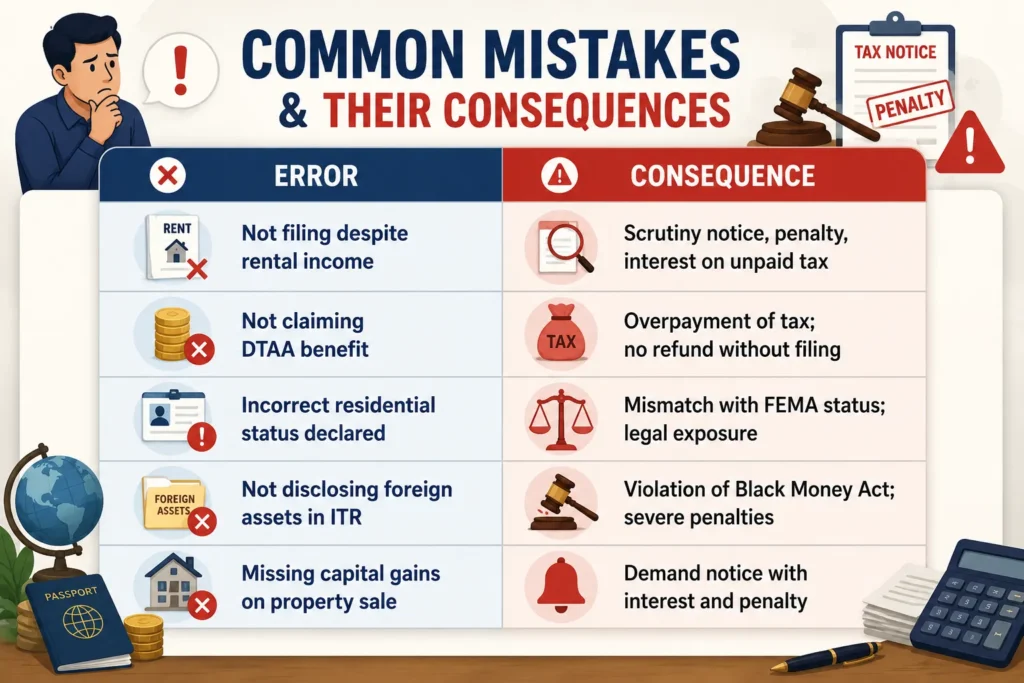
If TDS has been deducted on your income and you are in a lower tax bracket (or eligible for DTAA relief), you can only claim a refund by filing a return. The money is simply forfeited if you don’t file.
The Double Taxation Trap
India has DTAAs with over 90 countries — including the US, UK, UAE, Canada, Australia, Singapore, and Germany. These agreements prevent the same income from being taxed twice. But DTAA benefits are not automatic. You must:
- Obtain a Tax Residency Certificate (TRC) from your country of residence
- Submit Form 10F to the Indian deductor (bank, tenant, mutual fund)
- File your Indian return to claim the treaty benefit
NRIs who skip this process often pay full 30% TDS on NRO income — when they were entitled to a reduced rate of 10–15% under the applicable DTAA. Over years and across multiple income sources, this overpayment compounds significantly.
Mistake 3 — The Wrong Mutual Fund Folio Problem
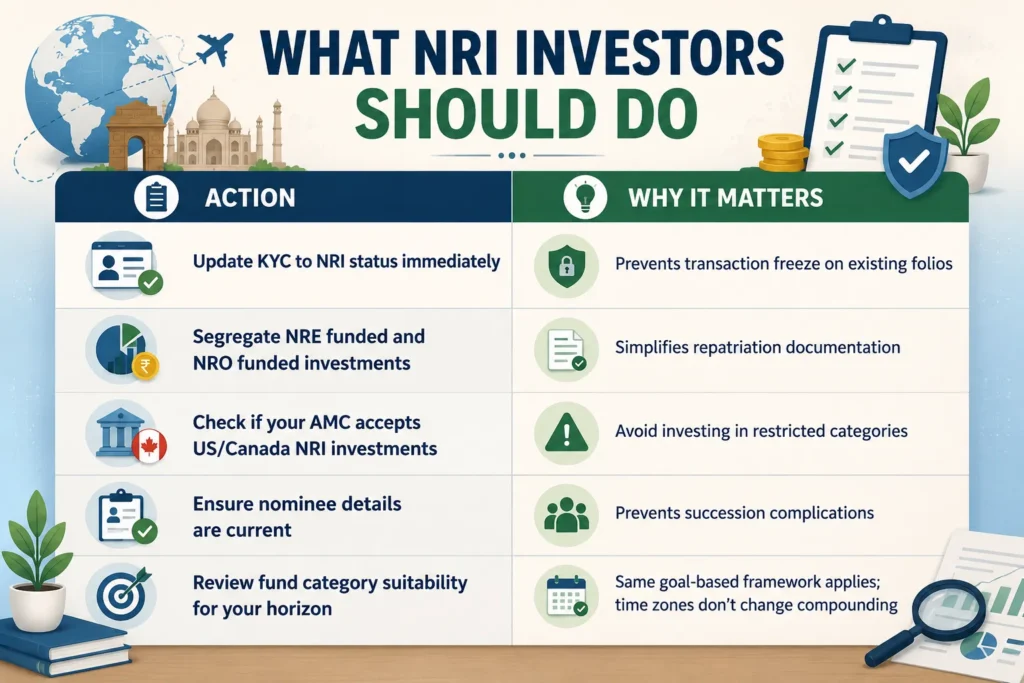
If you invested in mutual funds as a resident Indian and then became an NRI without updating your KYC, your existing folios are technically non-compliant. Most fund houses flag these accounts and restrict further transactions — including redemptions — until the NRI KYC is updated.
NRI mutual fund investing in India — the key restrictions
Not all mutual fund categories are accessible to NRIs from all geographies. US and Canada-based NRIs face the most restrictions due to FATCA (Foreign Account Tax Compliance Act) requirements. Many Indian AMCs do not accept investments from US/Canada-based NRIs because of the compliance burden. Those that do, often require additional paperwork, including a W-8BEN form.
Repatriation of mutual fund proceeds
This is where the side-account mistake bites again. If mutual fund redemption proceeds are credited to an NRO account, repatriation is subject to the annual USD 1 million limit and requires a CA certificate (Form 15CA/15CB). If the folio was funded from NRE account money, proceeds should flow back to the NRE account and are fully repatriable.
Mixing these — redeeming a fund purchased with foreign money but taking the proceeds into an NRO account — creates documentation headaches that are entirely avoidable.
Mistake 4 — Unmanaged Real Estate and the Power of Attorney Pitfall
For many NRI families, India means property. A flat in Chennai. An ancestral plot in Punjab. A shop inherited from a parent. Real estate is the most emotionally loaded and legally complex asset class for NRIs.
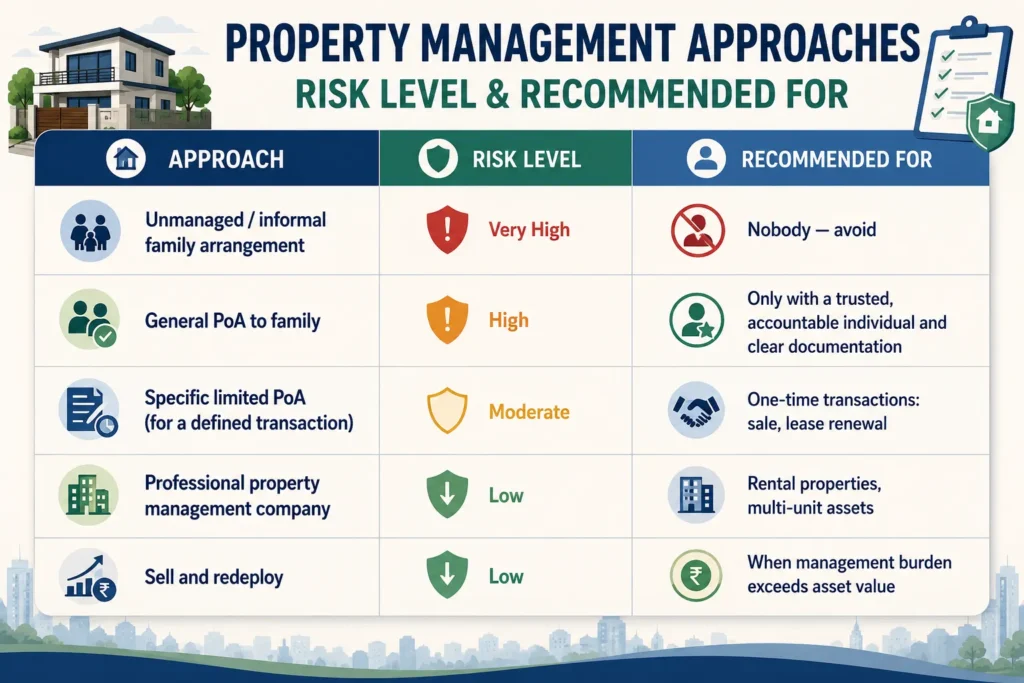
The “manage it from afar” approach typically involves one of two things: a trusted family member, or a Power of Attorney (PoA). Both can go wrong.
The family member trap
Handing informal control of an asset to a family member without legal documentation is not management — it is hope. There is no accountability, no paper trail, and in the event of a dispute or the person’s death, no clarity on authority. Rental income may not be deposited correctly. Property tax may go unpaid. Encroachments may go unreported.
The PoA problem
A Power of Attorney is a valid legal instrument. But a badly drafted PoA — or one given to the wrong person — creates risks:
- Overreach: A general PoA gives the holder near-unlimited authority over your assets in India. Specific, limited PoAs are safer.
- Revocability: Many NRIs don’t know their PoA can be misused before they can revoke it, especially when the holder is in India and the NRI is abroad.
- Registration: An unregistered PoA has limited legal standing for property transactions. For sale or purchase of immovable property, the PoA must be registered and in some cases notarised.
- Executor vs. beneficiary conflict: Giving a PoA to someone who is also a potential heir in your will creates a conflict of interest that courts have consistently frowned upon.
NRI property management in India — what actually works
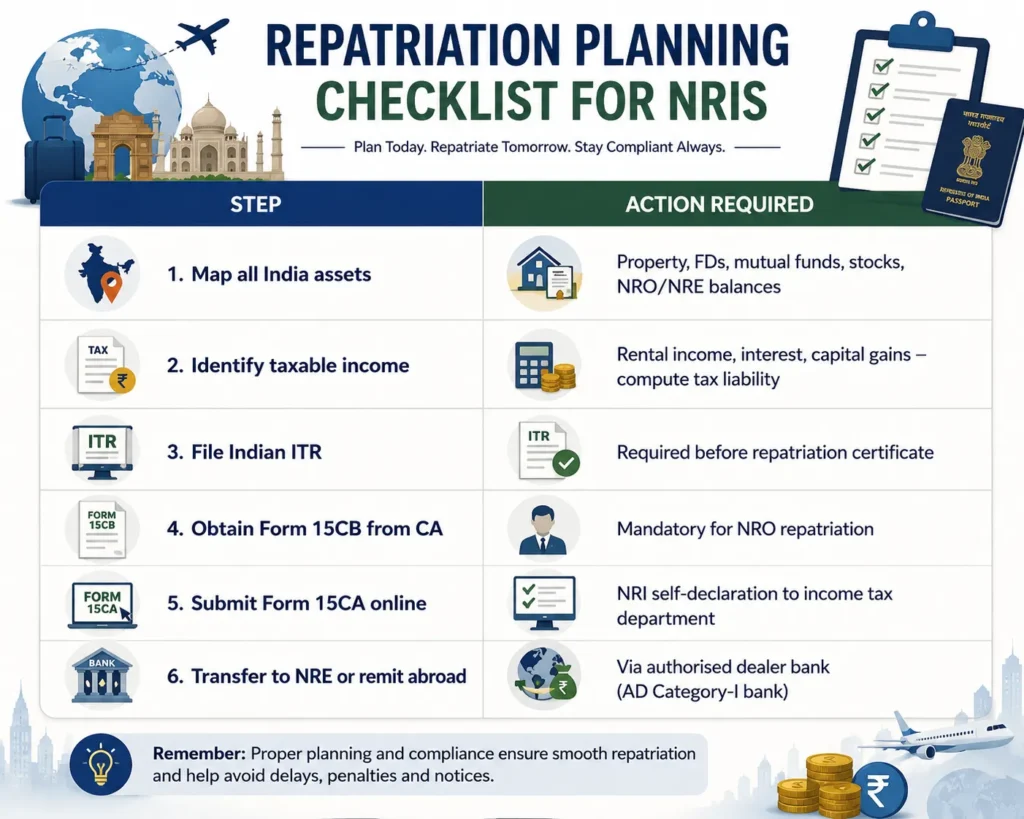
Mistake 5 — Not Planning for Repatriation Early Enough
The goal of most NRI investors in India is, at some point, to bring money back — either for a need abroad, or upon return to India. Repatriation sounds simple. It is not.
NRE account — clean, but limited in source
Money in an NRE account is fully repatriable at any time, without limit or tax. But it can only be funded with foreign earnings. So if your India money is sitting in an NRO account, a mutual fund folio, or a property, getting it out requires jumping through hoops.
NRO account repatriation rules
- Maximum USD 1 million per financial year (per NRI, not per account)
- Requires Form 15CA (self-declaration) and Form 15CB (CA certificate certifying tax compliance)
- TDS must have been paid or applicable tax settled before repatriation
- Property sale proceeds add additional complexity: TDS on sale is deducted by the buyer at source (typically 20–22.8% for NRIs on long-term capital gains), and then the NRI must file a return to claim any excess back before repatriating
The timing problem
Many NRIs plan to repatriate money “when they return to India.” But the moment they return and become residents again, the rules change. Resident Indians face different FEMA rules, and the repatriation window for accumulated NRI assets effectively closes. Planning repatriation while you are still an NRI — with a proper CA and authorised dealer bank — is vastly simpler.
Mistake 6 — Ignoring Succession and Nomination
Death is not a comfortable topic. But for NRIs with assets spread across two countries and possibly two legal systems, the lack of succession planning is a ticking time bomb for the family.
Why Indian nominations don’t work the way you think
A nomination in a bank account or mutual fund in India does not make the nominee the legal owner. The nominee is a trustee — they receive the asset, but must then distribute it according to the legal heirs as per applicable succession law (Hindu Succession Act, Indian Succession Act, or personal law, depending on religion and community). If your will says one thing and your nominee is another person, your family will end up in court.
The NRI will problem
If an NRI has assets in India and a will made abroad (say, a US will), that will may not automatically cover Indian immovable property. Indian property succession is governed by Indian law. A separate Indian will — registered and unambiguous — is often necessary to ensure your wishes are carried out without litigation.
What a proper NRI succession plan includes
- A registered Indian will covering all immovable property in India
- Updated nominations on all financial assets (bank accounts, MFs, stocks, insurance)
- Alignment between nominees and legal heirs (or a clearly documented trust structure if they differ)
- A letter of instruction to family members listing all India assets, account numbers, and contact details for advisors
- An NRI-familiar estate attorney in both countries who understands cross-border succession
How SubhShanti Wealth Helps You Manage India Money — Without the Stress
Managing your finances in India while living abroad shouldn’t feel like a second job. At SubhShanti Wealth, we act as your trusted financial anchor in India — so your money stays compliant, organised, and working towards your goals, whether you are in Dubai, Toronto, or Singapore.
Here is how we help:
1. Getting Your Accounts Right From Day One: The moment your residential status changes, so do your banking obligations. We help you identify which of your existing accounts need to be converted, explain the difference between NRE and NRO accounts in plain language, and connect you with the right banking relationships — so your India money sits in the right place, legally and efficiently, from the start.
2. Tax Compliance, Simplified: From filing your Indian income tax return to helping you claim DTAA benefits on your NRO interest — we coordinate with qualified Chartered Accountants who specialise in NRI taxation. Whether it is rental income, capital gains from a property sale, or dividends from your portfolio, we ensure nothing is missed and no more tax is paid than what is legally owed
3. Goal-Based Investment Planning for Your India Portfolio: Your India investments deserve the same structure as your investments abroad. We map your financial goals — an emergency buffer, a child’s education, a retirement corpus, or long-term wealth creation — to the right mutual fund categories, using a disciplined, goal-first framework. No chasing last year’s top performers. No products sold for commission. Just a plan that fits your life.
4. Property, Power of Attorney, and Succession: Handled with Care We help you put the right structures in place for your India assets — reviewing your Power of Attorney, coordinating with legal professionals for wills and nominations, and connecting you with reputable property managers for rental assets. So the people and paperwork protecting your India wealth are as solid as the assets themselves.
5. One Point of Contact. Complete Picture: The biggest gap in NRI financial management is not a lack of products — it is a lack of coordination. Your banker, your CA, your property manager, and your investment advisor are all working in silos. SubhShanti Wealth brings it together. We give you a single, trusted relationship that looks at your entire India financial picture — and keeps you informed, without the jargon.
A Word on “NRI Financial Advisors” in India to avoid Portfolio Mistakes
The NRI segment has attracted a class of unregulated “advisors” — often agents of insurance companies or banks — who sell high-commission products (ULIPs, endowment plans) to NRIs visiting India, promising “tax-free returns” and “repatriation without limit.” Most of these claims are misleading or outright false.
When seeking advice on NRI financial management in India, work only with:
- SEBI-registered Investment Advisors (RIAs) for investment advice
- AMFI-registered Mutual Fund Distributors for fund selection
- Chartered Accountants with NRI tax expertise for filing, DTAA claims, and repatriation
- Registered advocates / estate attorneys for property, PoA, and succession matters
A good advisor in this space will tell you things you don’t want to hear — that your old savings account is non-compliant, that you have an unfiled return liability, that your PoA needs to be redrawn. That discomfort is the value. Advisors who only affirm your existing arrangements should be viewed with scepticism.
Final Thoughts: Distance is Not the Problem — Structure Is
The NRI side-account mistake is not born of negligence. It is born of the gap between two realities: life abroad is fast-moving, demanding, and absorbing. India feels close enough to manage later.
But financial and legal systems don’t wait. Accounts that are non-compliant accumulate risk. Tax liabilities that go unfiled attract interest and penalties. Properties that are unmanaged depreciate and invite disputes. And all of it lands on you — or on your family — at the worst possible time.
The solution is not to liquidate everything in India and bring it abroad. For many NRIs, India remains a significant source of long-term wealth. The solution is structure: the right accounts, the right tax filings, the right advisors, the right succession plan — put in place early and reviewed regularly.
You do not need to be physically present in India to manage India money well. You need a system that works while you aren’t.
Disclaimer: This blog is for educational and informational purposes only and does not constitute legal, tax, or financial advice. FEMA regulations, income tax provisions, and DTAA rules are subject to change. NRI financial and tax obligations vary significantly based on country of residence, type of assets, and individual circumstances. Please consult a qualified Chartered Accountant and SEBI-registered advisor for guidance specific to your situation.