


Your journey to wealth isn’t about predicting the next move, but about having the conviction to continue when it matters most.
Investing in equity markets is a journey filled with highs and lows, peaks and troughs. Every seasoned investor, regardless of experience, is tested when the market dips. The allure to pause systematic investment plans (SIPs) during turbulent times can be overwhelming—after all, it feels logical to hit the brakes until things “settle down.” But is this truly the right move for an expert investor, or does it threaten long-term wealth creation?
In this blog, we’ll unpack why pausing SIPs during market lows is a mistake, explore the psychological triggers behind it, and most importantly, show you the compelling evidence that continuing your SIP is the best thing you can do—even when the markets look grim.
Understanding SIPs: The Backbone of Long-Term Investing
Before diving deeper, let’s recall what a SIP really is. SIP, or Systematic Investment Plan, is an investment strategy where fixed sums are invested at regular intervals (typically monthly) into mutual funds, most commonly equity funds. This approach is built on the principle of disciplined investing and is designed to help investors navigate volatility through rupee cost averaging.
For seasoned investors, SIPs are less about market timing and more about harnessing the power of consistency and compound growth. The real magic happens not during market highs, but precisely when the markets are low—contrary to what your instincts may be telling you.
The Temptation to Pause SIPs: Why Even Experts Fall For It

Market downturns create a perfect storm of emotions:
- Fear: “What if the market keeps falling?”
- Doubt: “Should I wait until things get better?”
- Rationalization: “I could pause SIPs and restart when the market recovers!”
Even seasoned investors aren’t immune to these thoughts. Years of experience and knowledge might make you more analytical, but emotions can still drive decisions. The problem isn’t whether you’re capable—the issue is that pausing your SIP feels like an ‘active measure,’ yet it’s fundamentally a counterproductive strategy.
The decision to pause a SIP rarely comes from data—it comes from discomfort. If this urge feels familiar, it’s worth revisiting “The 5-Minute Rule to Test If You’re Investing Emotionally”, which breaks down a simple framework to distinguish rational portfolio decisions from emotionally driven reactions during market stress.
The Consequences of Pausing SIPs During Market Lows
1. Missing Out on the Power of Rupee Cost Averaging
Rupee cost averaging allows you to buy more mutual fund units when markets are down (lower NAV), and fewer units when markets are high (higher NAV). By pausing SIPs in a downturn, you miss the opportunity to accumulate extra units at lower prices—units that can drive extraordinary returns when markets rebound.
Consider this: If you stop investing during bearish phases (market down phases), you effectively pay a premium for the same assets when the markets recover. This erodes your long-term returns.
2. Losing the Game
Wealth creation through SIPs is anchored in the power of compounding. Each contribution, no matter how small, grows and multiplies over time. Even missing a few installments can drastically reduce your final corpus because future growth will be calculated on a smaller base.
3. An Illusion of Control
Many think they can pause investments and restart when the signals are “positive.” Yet, even professional fund managers struggle to time their entries perfectly. Historical data repeatedly shows that investors lose more by missing just a few good days of market recovery than they gain by skipping the bad days. By pausing your SIP, you risk locking yourself out of the inevitable rebound.
4. Emotional Investing: A Vicious Cycle
Pausing SIPs is proof that emotion, not logic, is driving your decisions. This sets off a vicious cycle—fear leads to inaction, inaction leads to missed opportunities, and missed opportunities breed more fear and regret. Breaking this cycle is crucial for seasoned investors striving for optimal returns.
Data Shows : The Impact of SIP Pauses
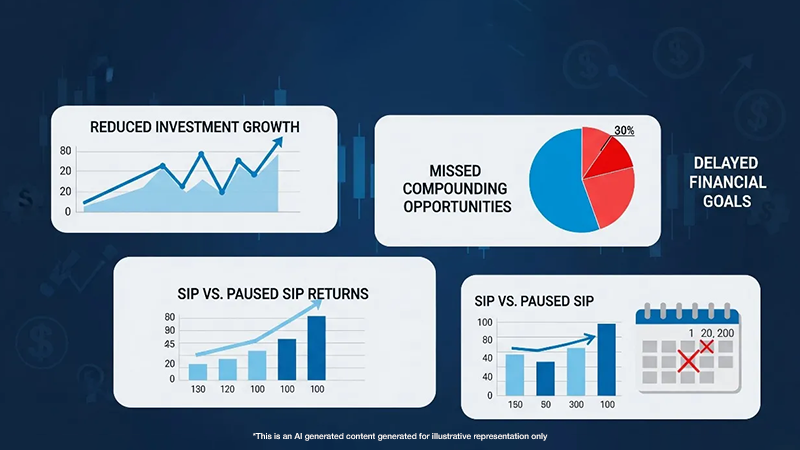
Let’s look at a hypothetical scenario featuring two seasoned investors:
- Investor A continues SIP through a market crash.
- Investor B pauses SIP during lows and resumes after the recovery.
Suppose the market drops 30%, then rebounds 40% a year later. Investor A accumulates more units at low prices during the downturn. When the market rebounds, their portfolio surges because those cheap units appreciate in value. Investor B, meanwhile, resumes investing only when NAVs are higher, buying fewer units and gaining less from the recovery. Over 10–15 years, these differences compound, creating a significant gap in wealth accumulation—even for investors with identical skills and knowledge.
The Psychology of Wealth Creation
Every investor dreams of buying low and selling high. SIPs enable this without you having to think about it—automatic allocations during market lows ensure you buy at the right time, even if your gut is telling you otherwise.
Discipline is everything. By sticking to your SIP, you let market cycles work to your advantage rather than becoming a slave to them. This is where seasoned investors distinguish themselves from the crowd.
Why Pausing Feels Like Control, But Isn’t

Let’s address some common justifications for pausing SIP:
- “I want to wait for certainty.”
Markets are never certain. Waiting for a clear trend guarantees you buy at higher prices. - “Let me avoid short-term losses.”
Remember, losses are only on paper unless you sell. SIPs are designed to turn volatility into long-term gains. - “I’ll invest in lumpsum when the market bottoms.”
Finding the bottom is as challenging as picking the top. Historical evidence suggests most investors either miss the bottom or buy too late. - “I don’t want to invest in a falling market.”
This is precisely the best time to buy for long-term investors. Falling markets mean discounted prices for quality assets.
An Example
Imagine you started a SIP of ₹10,000 per month in an equity mutual fund. Over 15 years, you would have invested ₹1,800,000. If your SIP continued even through market lows, historical equity returns suggest your corpus could grow to nearly ₹5,000,000 or more. Missing just one year of SIP during a crash can reduce your corpus by as much as 10–15%. Consistency, therefore, is not just a virtue—it’s a financial necessity.
What Should Seasoned Investors Do During Market Lows?

1. Stay the Course: Trust the process. SIPs are designed to work over volatility, not to avoid it.
2. Increase Contributions: If you have surplus cash, consider increasing your SIP amount during downturns to maximize the benefit of lower NAVs.
3. Revisit Asset Allocation: Rather than pausing SIPs, re-evaluate your portfolio to ensure it matches your risk tolerance and time horizon.
4. Avoid Emotional Reactions: Reaffirm your investment thesis. Remind yourself that volatility is temporary, but discipline creates lasting wealth.
Staying invested through SIPs is only one side of disciplined investing. Equally important is ensuring your portfolio doesn’t drift into unintended risk during volatile phases. This is where “Rebalancing: The Understated Discipline That Keeps Portfolios Healthy” explains how long-term investors use market corrections to realign—not retreat—from their financial strategy.
Real-Life Insights: What Successful Investors Do
History is littered with examples of investors who stayed invested during market downturns—and reaped outsized rewards when the tide turned. From Warren Buffett’s legendary contrarian moves to Indian mutual fund investors who continued their SIPs through the COVID crash, the evidence is clear: staying invested, especially through crisis, positions you for the strongest comebacks.
Let Your SIP Hydrate Your Wallet during Market Dehydration!
Pausing your SIP during market lows not only deprives you of the best periods for unit accumulation but also exposes you to the volatility of market timing. For seasoned investors, market corrections are not obstacles—they are opportunities to build wealth at a discount.
Remember, the strength of your investing journey is not measured by how you act during sunny periods, but by your resolve during storms. The next time markets look bleak and the urge to pause arises, remind yourself: the long-term reward goes to those who stay the course, invest consistently, and let discipline—not fear—dictate their strategy.
So, resist the urge to hit pause on your SIPs. The markets, and your future self, will thank you.
Disclaimer
This article is intended solely for educational and informational purposes. It does not constitute investment advice, trading recommendations, or a solicitation to buy or sell any securities or financial instruments. The views expressed are based on publicly available data, regulatory studies, and industry observations, including reports published by the Securities and Exchange Board of India (SEBI). Readers are advised to assess their financial objectives, risk appetite, and suitability before making any investment or trading decisions. Derivatives trading, including Futures & Options (F&O), involves substantial risk and may not be suitable for all investors. Past performance is not indicative of future results. Investors should consult a SEBI-registered investment adviser or other qualified financial professional before acting on any information presented herein.