

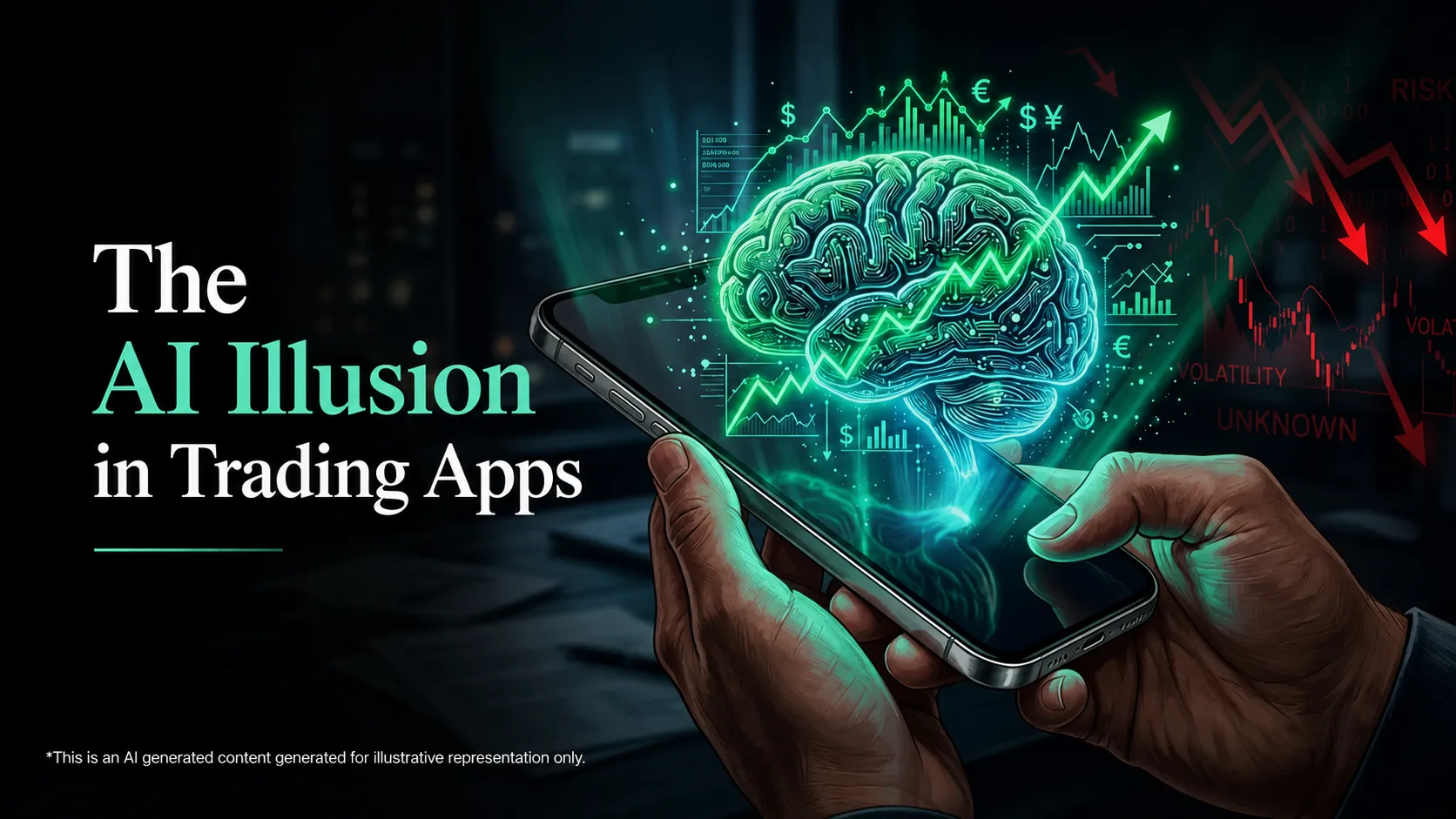
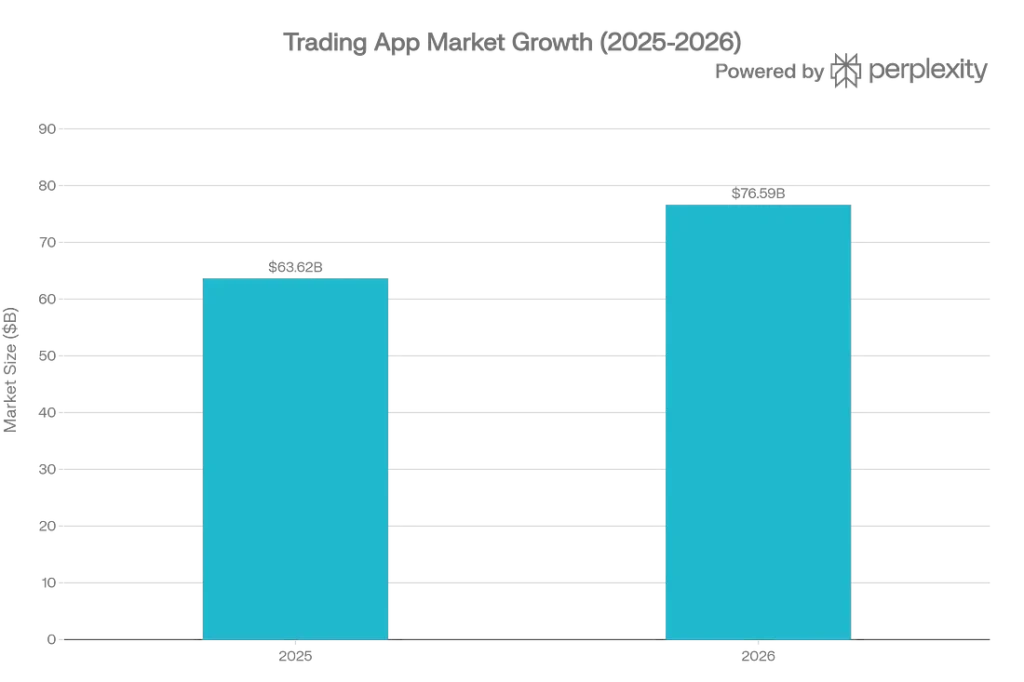
In the past two years, trading apps have evolved from basic buy-sell tools into full-fledged, mobile-first investment platforms with features like portfolio tracking, AI-led insights, and personalized guidance. The scale of this shift is clear from the market’s growth from $63.62 billion in 2025 to $76.59 billion in 2026. What was once a simple buy-sell interface now comes layered with predictive analytics, sentiment tracking, AI-generated insights, and chatbot-based market guidance.
The promise is seductive:
– Data-backed decisions.
– Emotion-free trades.
– Institutional-level intelligence in your pocket.
The reality is more complex.
Across global markets—and increasingly in India— We have witnessed a growing pattern. Investors are bypassing experienced advisors, choosing instead to “ask AI” for stock picks, timing strategies, and portfolio direction. The rationale is easily grasped: AI appears to be unbiased, instantly accessible, and incurs no cost. Consequently, the justification for retaining a specialist diminishes when an algorithm provides immediate solutions.
This blog is based documented incidents, regulatory data, and retail trading research, the outcomes consistently reveal one truth:
AI can assist decisions. It cannot replace judgment.
Let us examine the top 5 mistakes investors are making.
1. Unclear Trends in Forecast
AI systems embedded in trading platforms primarily rely on historical data. They identify correlations, trends, and recurring behaviors. However, markets are influenced by geopolitical shocks, regulatory shifts, liquidity cycles, and human psychology—variables that are not always embedded in training datasets.
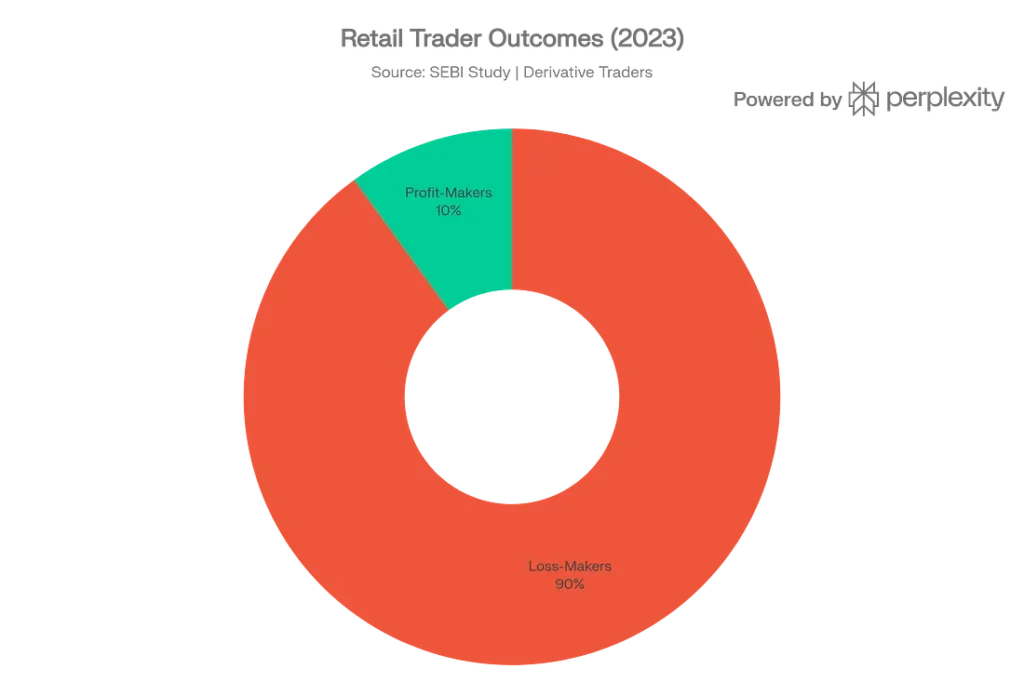
In 2021–2022, retail investors globally increased participation in equity markets, often influenced by app-based alerts and sentiment analytics. According to the Securities and Exchange Board of India (SEBI) study on retail trading behavior (2023), over 90% of individual derivative traders incurred net losses.
AI did not prevent those losses.
Because pattern recognition is not foresight.
Markets are adaptive systems. When conditions change, historical models lose reliability. Overreliance on AI-generated signals often leads investors to assume a higher probability of success than actually exists.
That assumption is expensive.
2. Treating AI Advice as Personalised Financial Planning
AI chat tools embedded in trading apps provide generalised responses. There is no universal “best” investment, only what is best for you. Your financial blueprint is completely unique, shaped by your specific life stage, goals, income, and risk appetite.
Because of this, product suitability is everything. A great financial product can be entirely wrong for the wrong investor:
- 📈 Equity (Mutual Funds/Stocks): Great for 10-year wealth building; terrible for next year’s house down payment.
- 🛡️ Liquid Funds & FDs: Perfect for safe, emergency cash; ineffective for beating long-term inflation.
- ☂️ Term Insurance: Essential to protect your family’s future; not a tool for generating investment returns.
Don’t chase market trends or copy someone else’s portfolio. Match the financial product directly to your unique destination and timeline.
The Pillars of a True Financial Plan
A comprehensive financial plan is a complete blueprint for your financial well-being, providing:
- Goal Mapping: A clear roadmap connecting your current wealth to life goals.
- Cashflow Management: Balances income and expenses for strategic investments and a desired standard of living.
- Risk Management & Insurance: A protective financial shield against unforeseen life events.
- Estate Planning: Ensures a smooth, secure, and legal transfer of your legacy via wills and trusts.
- Liquidity & Emergency Planning: A reliable safety net of accessible funds for unexpected needs without disrupting long-term investments.
- Tax Optimization: Efficiently structures finances to minimize tax liabilities and maximize actual returns.
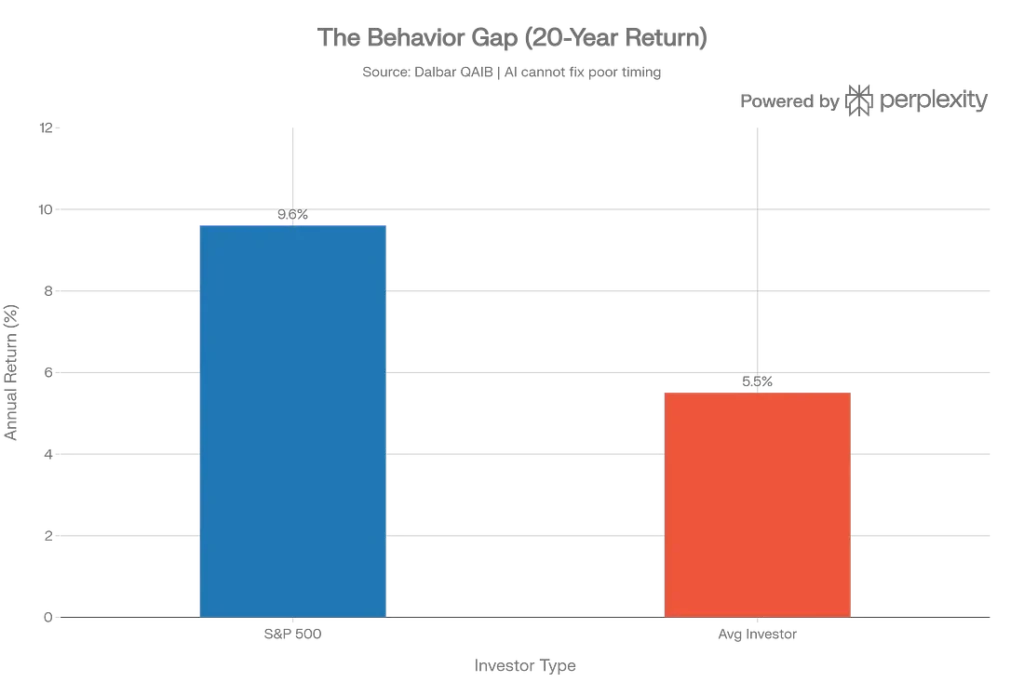
The Dalbar Quantitative Analysis of Investor Behavior (QAIB) consistently shows that average investors underperform the broader market due to poor timing decisions.
Technology has not eliminated this gap.
When individuals rely on AI prompts like “Is this a good time to buy?” they receive probabilistic responses—not fiduciary responsibility.
The distinction matters.
3. Overtrading Due to Algorithmic Nudges
AI-powered platforms are designed to increase engagement. Notifications, opportunity alerts, volatility signals—these features create urgency.
Research published by the Barber and Odean study (University of California) on trading frequency demonstrated that higher trading activity significantly reduces net returns for retail investors, primarily due to costs and poor timing.
In India, SEBI’s data also highlights that a large percentage of new demat accounts engage heavily in derivatives trading without sufficient understanding of risk.
AI signals can boost overconfidence. More trades often mean higher costs and emotional decisions disguised as data-driven action.
4. Ignoring Risk Management Because “AI Has It Covered”
One of the most dangerous psychological shifts I have observed is this: investors assume that because AI analyses data at scale, downside risk is automatically managed.
It is not.
AI models can suggest stop-loss levels or volatility measures, but they cannot protect against black swan events—rare, high-impact disruptions such as:
- Sudden regulatory bans
- Global liquidity shocks
- Currency crises
- Corporate governance failures
The 2020 pandemic crash is a stark reminder. Even institutional quant models struggled with the velocity of the drawdown. Risk management requires allocation discipline, not just trade signals.
Technology does not eliminate uncertainty. It simply processes information faster.
5. Choosing Free AI Over Paid Expertise Without Understanding the Cost
There is a growing perception that expert advice is expensive, while AI is cost-effective.
However, the true cost of financial decisions is measured in capital erosion.
Professional advisors operate within regulatory frameworks, fiduciary standards, and structured asset allocation models. Their accountability extends beyond suggestions—they are responsible for long-term strategy alignment.
AI tools are not liable for losses.
A client recently approached after losing a substantial portion of capital through AI-assisted derivative trades. The strategy appeared sophisticated—volatility indicators, machine-generated buy signals, automated exit points. What it lacked was suitability assessment.
The losses were not due to technology failure.
They were due to misapplication.
The True Incident Behind This Analysis
Note: This is a composite case based on recurring industry patterns, regulatory findings, and experts’ experience. Any resemblance to specific individuals is coincidental. Names and identifying details have been anonymised to protect privacy.
In mid-2024, a 32-year-old salaried professional from Mumbai approached a registered financial firm after losing approximately ₹18 lakhs within eight months.
He had started trading actively through an AI-enabled brokerage app that promoted:
- Real-time sentiment analysis
- AI-driven entry and exit signals
- Automated derivative trade suggestions
He did not consult a financial advisor because, in his words, “the AI dashboard already analyses more data than any human can.”
Initially, small gains reinforced confidence. The app’s algorithm identified momentum opportunities in index options and high-beta stocks. Encouraged by early success, he increased position sizes and began trading weekly expiry options.
Three structural issues emerged:
- No capital allocation framework – Nearly 70% of investable surplus was exposed to derivatives.
- No downside containment strategy – Stop-loss levels were frequently modified when trades moved against him.
- No suitability assessment – The strategy did not align with his income stability, financial goals, or risk capacity.
When market volatility spiked following global macroeconomic uncertainty and foreign institutional investor outflows, leveraged positions deteriorated rapidly.
The AI system generated revised signals.
- But it did not reduce exposure.
- It did not intervene emotionally.
- It did not reassess suitability.
By the time he sought professional help, portfolio erosion had compounded due to leverage and transaction costs.
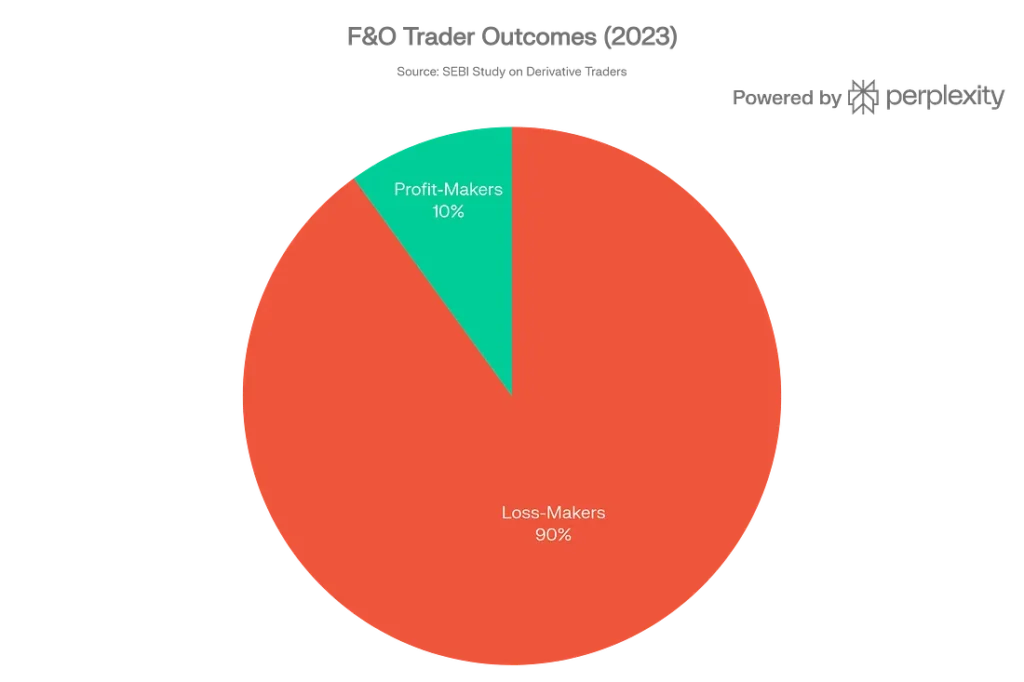
This case is not isolated. According to the Securities and Exchange Board of India (SEBI) 2023 study on F&O trading behavior, over 90% of individual traders in derivatives incurred net losses. Many of these participants were first-time traders influenced by digital platforms and algorithmic tools.
Why This Matters
AI trading models are built on probability distributions, but financial lives are measured by consequences. The critical difference between these two is accountability.
The recovery strategy for a client who faced challenges with these tools centered on fundamental principles of wealth management:
- Rebuilding a solid asset allocation structure.
- Defining and limiting speculative exposure to a controlled percentage.
- Establishing robust emergency liquidity buffers.
- Shifting the primary focus from volatile short-term trading to steady, long-term compounding.
This experience taught a vital lesson: the issue is not that AI itself is inherently harmful, but that any powerful tool demands proper governance and control.
The Psychological Factor AI Cannot Eliminate
The reality of the market is that it is often driven by sentiment and prevailing narratives rather than purely by objective financial metrics.
While AI excels at data analysis and sentiment sensing, it just doesn’t have what it takes to build up that essential investor instinct or the discipline needed to stick to a long-term plan.
Behavioral finance consistently identifies the primary challenge for investors as navigating market volatility, particularly during periods of extreme euphoria or panic. An algorithm cannot provide the necessary guidance to an investor during these high-stress, emotional phases—moments that are demonstrably critical in driving market movement.
What the Data Actually Says
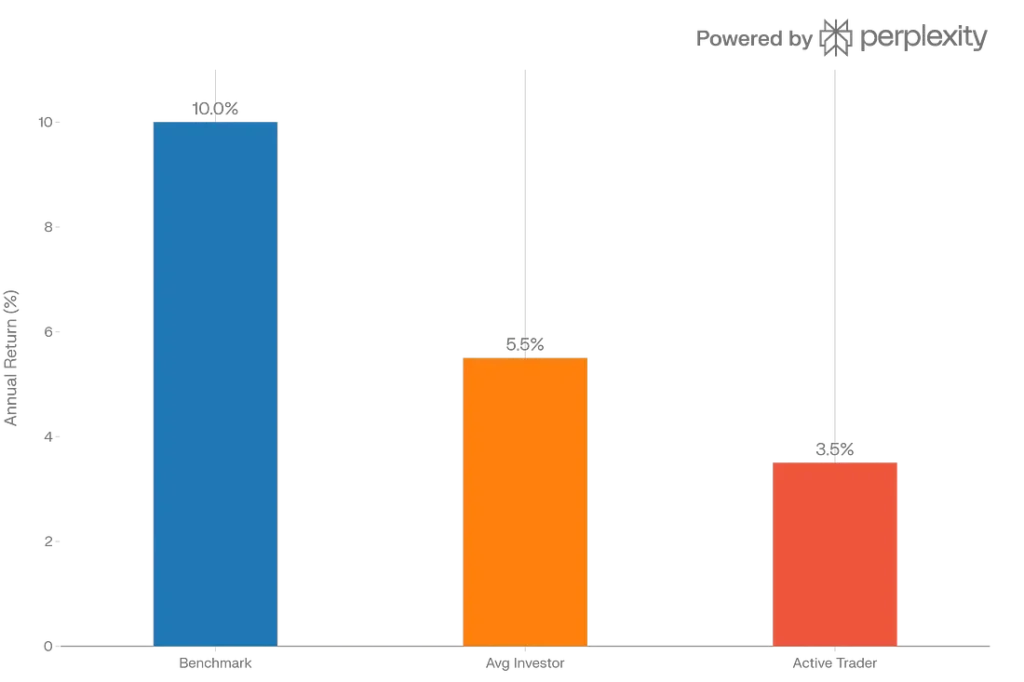
- SEBI Study (2023): Over 90% of individual F&O traders incurred losses.
- Dalbar QAIB Reports: Average equity investor underperforms benchmark indices over long periods due to behavioural errors.
- Barber & Odean Research: Excessive trading reduces investor returns significantly.
Technology improves access. It does not guarantee outcomes.
AI as a Tool, Not a Substitute
AI in trading apps is not inherently harmful. Used correctly, it may:
- Enhance research speed
- Provide data summaries
- Track sentiment trends
- Improve operational efficiency
Chatbot queries cannot replace strategic financial planning for sustainable investment. The market values discipline over convenience. Check out our AI vs Human robo-advisor blog for a fresh perspective on where automated strategies excel, where human judgement still wins, and what that means for positioning your portfolio today.
Final Perspective
Technology has successfully lowered the barriers to market entry, promoting greater participation and financial inclusion—a welcome development in the evolution of markets.
However, a critical distinction must be made: a highly sophisticated user interface does not equate to a highly sophisticated trading strategy. While AI possesses the power to enhance human intelligence, it also carries the risk of amplifying errors.
Ultimately, the factor that determines the outcome is human judgment, which remains irreplaceable.
Disclaimer
This article is intended solely for educational and informational purposes. It does not constitute investment advice, trading recommendations, or a solicitation to buy or sell any securities or financial instruments. The views expressed are based on publicly available data, regulatory studies, and industry observations, including reports published by the Securities and Exchange Board of India (SEBI). Readers are advised to assess their financial objectives, risk appetite, and suitability before making any investment or trading decisions. Derivatives trading, including Futures & Options (F&O), involves substantial risk and may not be suitable for all investors. Past performance is not indicative of future results. Investors should consult a SEBI-registered investment adviser or other qualified financial professional before acting on any information presented herein.