


Choosing a mutual fund is not a product decision — it is a goal decision. Most investors make the mistake of picking funds based on recent returns, star ratings, or what their neighbour is investing in. A seasoned distributor or financial expert does it differently. They start with the goal, map a timeline, and only then identify which category of fund fits. That framework is what this blog will walk you through — step by step, goal by goal.
Whether you are a salaried professional in Mumbai trying to build an emergency cushion, a young couple in Bengaluru saving for a home, or a parent in Delhi planning for your child’s college education, goal-based investing in India is the single most reliable method to align your money with your life.
Let’s break it down across four goal horizons.
Why Goal-Oriented Investing Matters in the Indian Context

Before we talk about any specific fund category, let us understand why the goal-first approach works.
When you invest without a goal, you have no benchmark for success. A 12% return sounds great — but is it? If your goal needed 14%, it’s a miss. If it only needed 10%, you may have taken unnecessary risk to chase that extra 2%.
Goal-based investing forces clarity on three things:
- How much money do you need? (the target corpus)
- When do you need it? (the time horizon)
- How much can you put in now, and frequency? (your investable surplus)
Once you answer these three questions, the fund category almost selects itself. Let’s see how, goal by goal.
Goal 1 — Emergency Fund (Liquid / Overnight Funds)
Time horizon: Immediate access required — 0 to 3 months
Ideal for: Salaried persons, self-employed individuals, anyone building a financial safety net
What is the goal?
Every financial plan must begin here. An emergency fund is not an investment — it is insurance for your cash flow. It is 3 to 6 months of your monthly expenses kept in a form that you can access within 24 hours if needed. A job loss, a medical emergency, a sudden home repair — these are not only “if” scenarios; they are “when” scenarios.
Which mutual fund category fits?
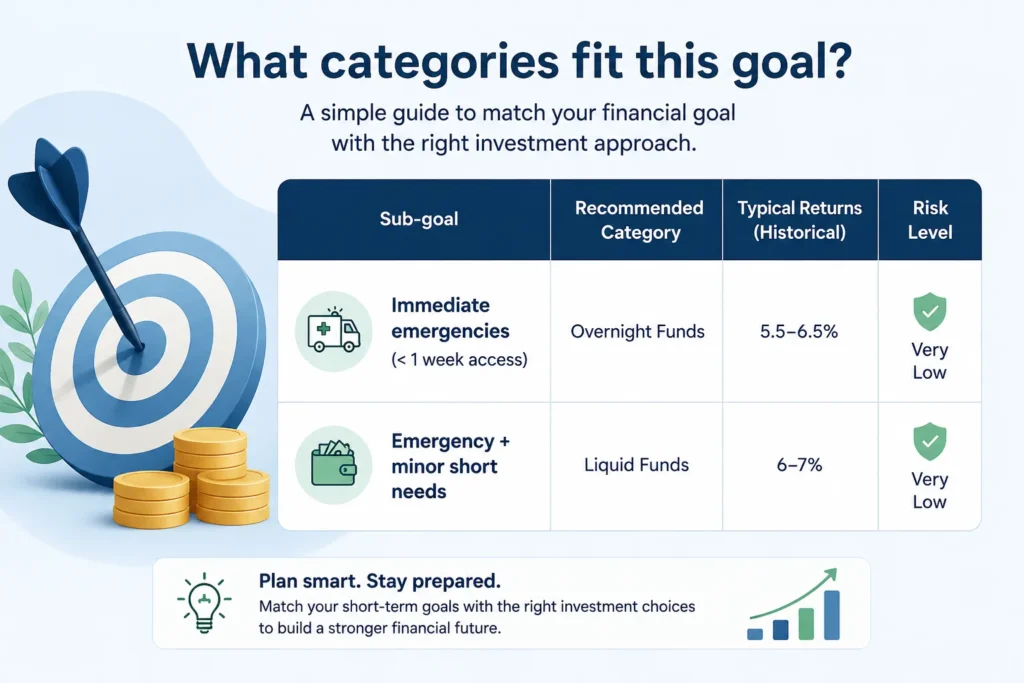
Liquid funds or overnight funds are the right choice here.
Liquid funds invest in instruments with a maturity of up to 91 days — treasury bills, commercial papers, certificates of deposit. Overnight funds go a step further: they invest only in instruments that mature the next business day, making them the safest category in the mutual fund universe.
Why not a savings account?
A savings bank account offers around 3–4% interest in most cases. Liquid funds have historically delivered 5–7% annualised returns, with near-zero volatility and no exit load after 7 days. You get better returns, easy withdrawal, and your money is not parked idle.
Why not a fixed deposit?
An FD penalises premature withdrawal. The whole point of an emergency fund is that it must be accessible without penalty. Liquid funds allow redemption and credit to your bank account within one business day (T+1 settlement for amounts up to ₹50,000 via IDCW option, and T+2 for regular redemptions in most cases).
What categories fit this goal?
Goal 2 — Short-Term Goals: 1 to 3 Years (Debt / Hybrid Funds)
Time horizon: 1 to 3 years
Examples: Family vacation, gadget purchase, car down payment, short-term home renovation
What is the goal?
Short-term goals are those you plan to fulfil in the next one to three years. For a salaried person in India, the most common short-term financial goals include a down payment for a vehicle, a foreign vacation, or an annual premium for a term or health insurance plan they are building reserves for.
The core challenge here: you need growth above inflation, but you cannot afford the kind of volatility that equity brings. If the market falls 10% in month 18 and your goal is in month 24, you have a problem.
Which mutual fund category fits?
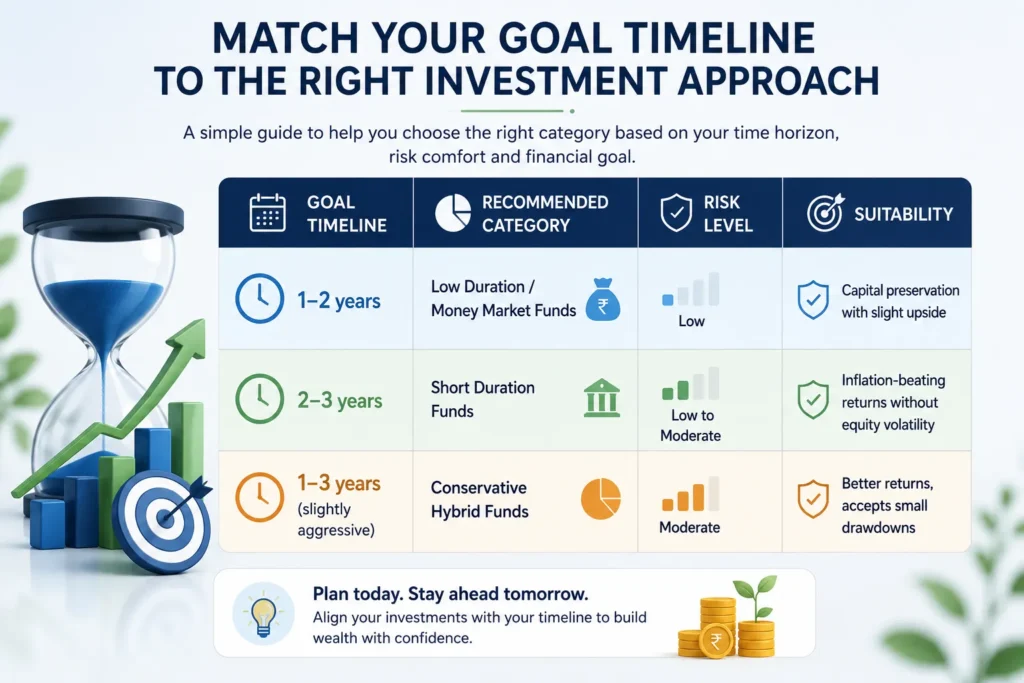
Low duration funds, short duration funds, and conservative hybrid funds are the three categories best suited for 1–3 year goals.
- Low duration funds hold instruments with a maturity of 6 to 12 months. They offer better returns than liquid funds with marginally higher (but still low) volatility.
- Short duration funds hold debt instruments maturing in 1 to 3 years — perfectly matching the goal horizon.
- Conservative hybrid funds hold 75–90% in debt and 10–25% in equity, giving a small kicker of equity returns while keeping the portfolio stable.
Why not equity for 1–3 years?
This is one of the most common mistakes investors make — putting money for a short-term goal into equity funds because “the market is doing well.” Equity markets can be down 20% in any given year. A 3-year horizon is not sufficient to ride out a full market cycle. The best mutual fund for salaried persons planning short-term goals should prioritise capital preservation over returns.
What categories fit this goal?
Goal 3 — Medium-Term Goals: 3 to 7 Years (Hybrid / Flexi-Cap Funds)
Time horizon: 3 to 7 years
Examples: House down payment, higher education savings, starting a business
What is the goal?
The 3–7 year window is where compounding begins to show up meaningfully. This is also the horizon where equity starts to make sense but not in its pure, aggressive form. Historically, Indian equity markets have delivered positive returns in most 5-year rolling periods. But volatility is still real, and you cannot afford to be 100% exposed to equity if the goal is time-bound and non-negotiable (like higher education fees).
This is the “mutual fund for 5 years India” search in action — and it is one of the most common questions asked by first-generation investors.
Which mutual fund category fits?
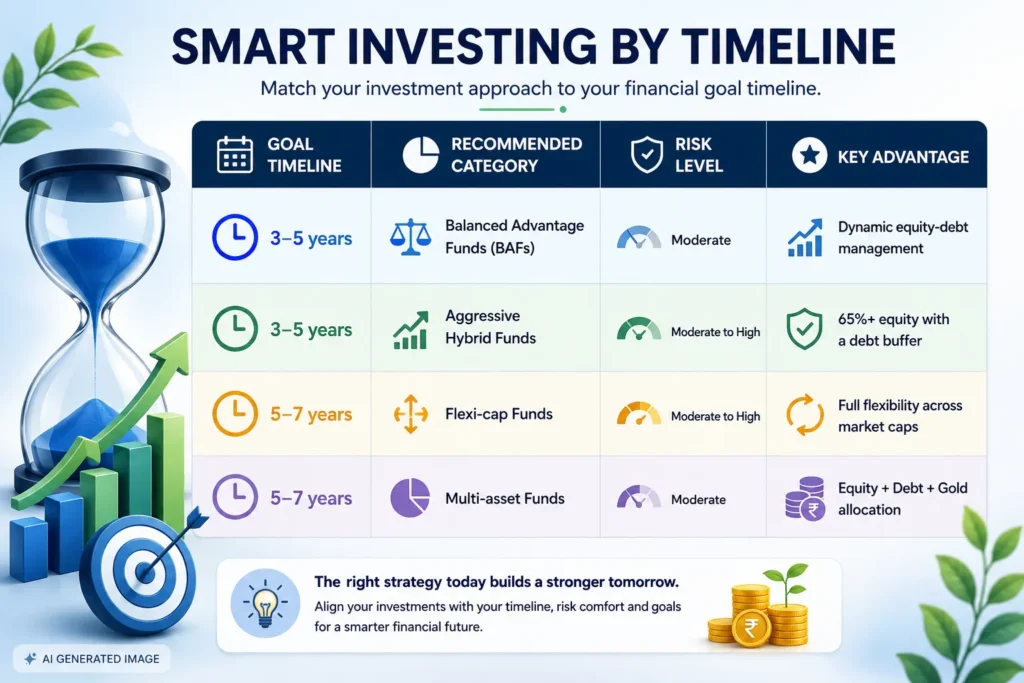
Balanced advantage funds (BAFs), flexi-cap funds, and aggressive hybrid funds are the primary categories for this horizon.
- Balanced Advantage Funds (BAFs): Also called dynamic asset allocation funds, BAFs use a model to decide how much to put in equity vs. debt at any given time. When markets are expensive, they reduce equity. When markets are cheap, they increase equity. This makes them ideal for goal-based investors who want equity exposure but are uncomfortable watching their portfolio swing 15% in a month.
- Flexi-cap Funds: These funds invest across large-cap, mid-cap, and small-cap stocks without restriction. They are managed actively and can shift allocation based on where value lies. Over 5–7 years, they have historically rewarded patient investors well.
- Aggressive Hybrid Funds: These hold 65–80% in equity and 20–35% in debt. They provide the growth engine of equity with a debt cushion that softens the blow in bear markets. For a salaried investor with a 5–7 year horizon and moderate risk appetite, this is often the sweet spot.
SIP is your best friend here
For medium-term goals, a Systematic Investment Plan (SIP) is highly recommended. SIPs average out your purchase cost over time, reducing the impact of market timing. If you are saving for a child’s school or college, starting an SIP in a balanced advantage or flexi-cap fund and reviewing it annually is a proven, research-backed approach.
What categories fit this goal?
Goal 4 — Long-Term Goals: 7+ Years (Equity Funds)
Time horizon: 7 years and beyond
Examples: Retirement corpus, child’s marriage, buying a home outright, wealth creation
What is the goal?
Long-term goals are where equity truly shines. Over rolling 10-year periods in India, equity mutual funds — particularly diversified funds — have historically delivered returns far superior to any fixed-income product. The longer your horizon, the more time you have to ride out market cycles, and the more the compounding effect works in your favour.
This is where goal-based investing in India becomes a genuine wealth-creation engine, not just a savings mechanism.
Which mutual fund category fits?
Large-cap funds, index funds, mid-cap funds, small-cap funds, ELSS funds, and sectoral/thematic funds all fall in this bucket — but with important nuances.
For the conservative long-term investor:
Large-cap funds and index funds (Nifty 50 / Nifty 100) are the starting point. Index funds track the benchmark passively, have lower expense ratios than actively managed funds, and are transparent in their holdings. For a first-time equity investor with a 10+ year horizon, a simple Nifty 50 index fund SIP is one of the best starting points in India today.
For the moderate long-term investor:
Flexi-cap funds and large & mid-cap funds offer a blend of stability (from large caps) and growth potential (from mid caps). They are actively managed and can outperform benchmarks over long periods if the fund manager has a consistent track record.
For the aggressive long-term investor:
Mid-cap funds and small-cap funds have delivered exceptional returns over 10–15 year horizons but come with significant volatility. They can fall 40–60% in a bear market. They are suitable only for investors who (a) have a genuine 10+ year horizon, (b) will not panic-sell during downturns, and (c) are investing a portion — not all — of their long-term corpus here.
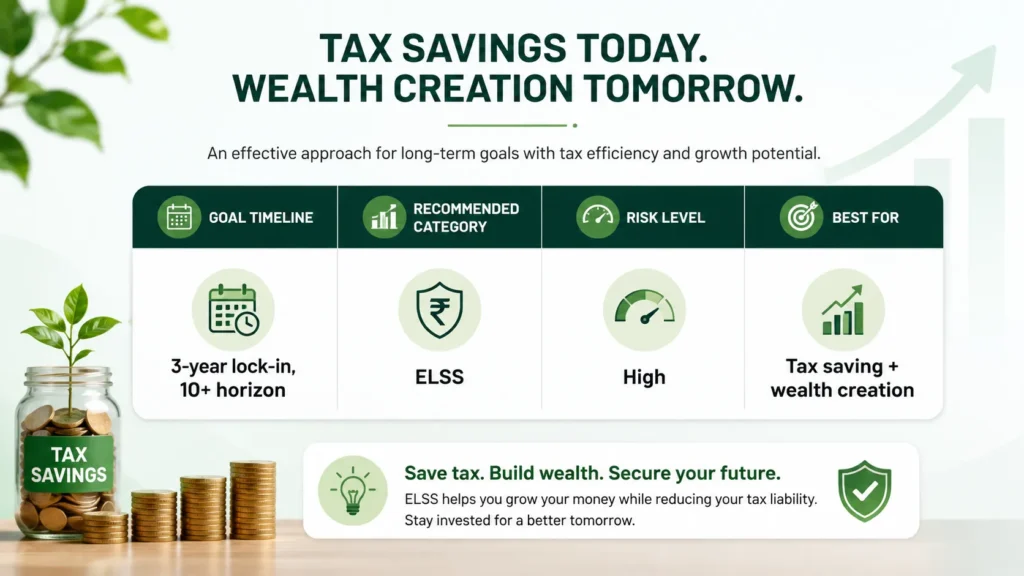
For tax-saving with a long horizon:
ELSS (Equity Linked Savings Scheme) is the best mutual fund for salaried persons who want to save tax under Section 80C while building long-term wealth. ELSS has a mandatory 3-year lock-in, the shortest among 80C instruments, and is invested predominantly in equity. If your employer’s PF and other deductions have not exhausted your ₹1.5 lakh 80C limit, ELSS is worth exploring (consult your tax expert for your specific situation).
What categories fit this goal?
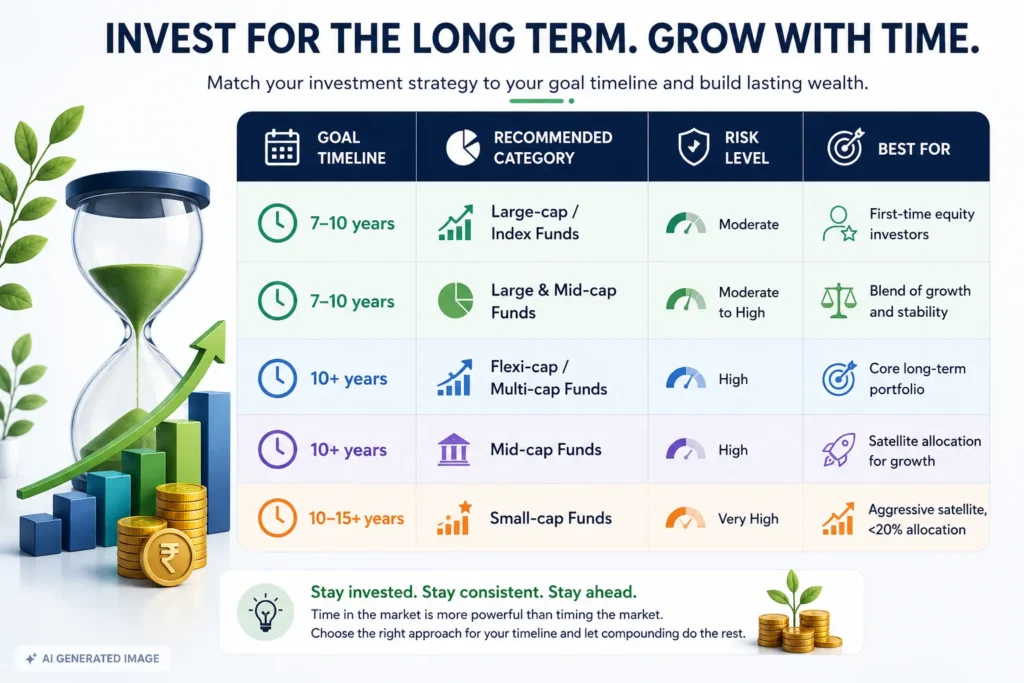
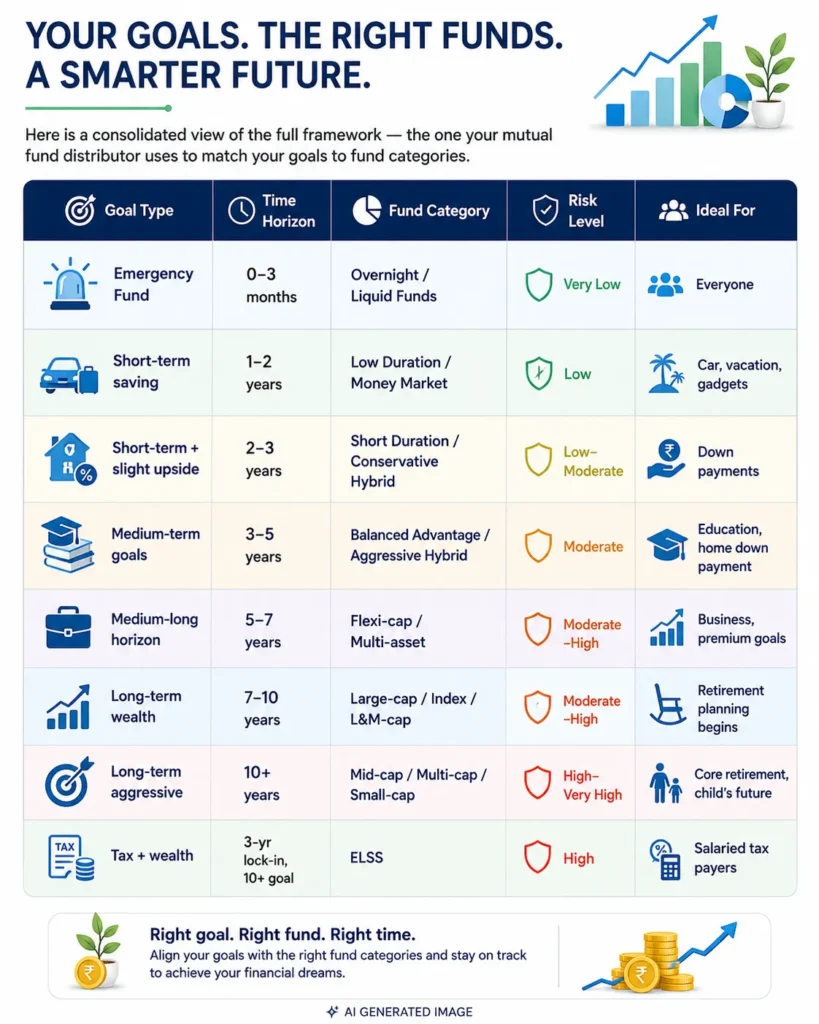
The Master Table: Goal-to-Fund
5 Common Mistakes to Avoid in Mutual Fund Investing
1. Picking a fund for the wrong time horizon
Putting a 2-year goal into a small-cap fund because the returns look great is the most dangerous mistake. Market cycles don’t respect your personal timelines.
2. Chasing last year’s best performers
A fund that gave 45% last year may have taken concentrated bets that won’t repeat. Category suitability for your goal is more important than last year’s return chart.
3. Ignoring inflation
A goal to accumulate ₹20 lakh in 10 years actually needs to be adjusted for inflation. If your child’s education costs ₹20 lakh today, it could cost ₹35–40 lakh in a decade. Factor this in.
4. Stopping SIPs during market corrections
This is when SIPs do their best work — buying more units at lower prices. Stopping SIPs during a downturn defeats the very logic of rupee cost averaging.
5. Not reviewing annually
Goal-based investing doesn’t mean “set and forget.” Review your portfolio once a year. If a fund has consistently underperformed its benchmark and category peers, discuss with your distributor.
A Quick Word for Salaried Investors
If you are a salaried professional, your financial life has a unique structure: regular monthly inflows, tax obligations under the old or new regime, and typically a mix of short-term and long-term goals running simultaneously. The best approach is a goal-bucket strategy:
- Bucket 1 (Emergency): 3–6 months of expenses in a liquid fund
- Bucket 2 (Short-term, 1–3 years): Conservative hybrid or short duration fund via SIP
- Bucket 3 (Medium-term, 3–7 years): Balanced advantage or flexi-cap fund via SIP
- Bucket 4 (Long-term, 7+ years): Index fund + mid-cap fund combination via SIP; ELSS for tax saving
Start with Bucket 1. Then move to Bucket 4, because compounding needs maximum time. Fill Bucket 2 and 3 as your income grows.
Final Thoughts
The right mutual fund for your goal isn’t the one with the best marketing or the highest 1-year return. It’s the one whose risk profile, return potential, and time horizon match your specific financial goal.
Goal-based investing in India is no longer just an expert’s framework — it is a mindset shift that any informed investor can adopt. Know your goal. Know your timeline. Know your risk appetite. Then pick the category. The specific fund within the category is the last step, not the first.
If you found this framework useful, share it with a friend who is still picking funds by star ratings alone. And if you want a personalized goal-to-fund mapping for your specific situation, consult a SEBI-registered investment expert or AMFI-registered mutual fund distributor.
Disclaimer: This blog is for educational and informational purposes only. It does not constitute investment advice. Mutual fund investments are subject to market risks. Please read all scheme-related documents carefully before investing. No specific scheme names have been recommended. Consult a SEBI-registered investment expert for advice tailored to your financial situation.