

For decades, precious-metals investors have looked to gold as the go-to hedge. But in 2025, silver is no longer playing second fiddle. Once considered a “poor cousin” to gold, silver is now grabbing attention — and for very good reason.
Several interlinked factors are propelling silver’s renaissance:
- Industrial Demand Surge
Over half of the world’s silver demand now comes from industrial use — not jewellery.- According to the most recent data from the Silver Institute, industrial demand reached 680.5 million ounces in 2024 — four times a consecutive record.
- Key growth areas: solar photovoltaics (PV), electric vehicles (EVs), electronics, telecommunications, and green-energy infrastructure.
- For instance, solar manufacturers rely on silver for PV panels because of its unmatched electrical conductivity.
- Supply Deficit
Demand is outpacing supply. The global market has recorded deficits for several years:- In 2024, the deficit stood at about 148.9 million ounces.
- According to some outlooks, 2025 may see an expected deficit of ~170 million ounces.
- Contributing factors include declining ore grades and reduced capital expenditure in primary silver mining.
- Tailwinds from Monetary and Currency Conditions
- When interest rates are low or falling, non-yielding assets like silver become more attractive.
- Because silver is priced in U.S. dollars, a weaker dollar (relative to local currencies like the rupee) makes silver more affordable for non-US buyers, boosting demand.
- In India specifically, rupee depreciation has amplified gains for domestic silver buyers in 2025.
- Investment Product Momentum
- In 2025, domestic silver prices in India have surged ~53% year-to-date, per recent reporting.
- Globally, silver-backed ETF inflows have accelerated strongly: approximately 95 million ounces added in H1 2025 alone, pushing total global ETF holdings to ~1.13 billion ounces (worth over US$ 40 billion) by mid-2025.
- In India, the Assets Under Management (AUM) of silver ETFs grew from ~₹7,473 crore in mid-2024 to about ₹16,866 crore by May 2025 — a ~125% surge.
Why Silver Isn’t Just Another Commodity — It’s a Strategic Investment
Given silver’s dual nature (precious metal + industrial commodity), it offers a compelling risk-return profile and some unique advantages for investors:
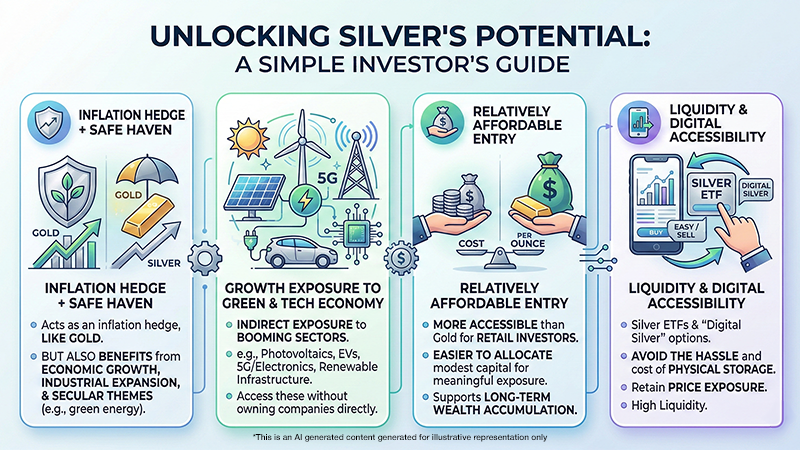
- Inflation Hedge + Safe Haven
Like gold, silver can act as an inflation hedge. But unlike gold, silver also benefits from economic growth, industrial expansion, and secular themes (e.g., green energy). - Growth Exposure to Green and Tech Economy
Investing in silver gives indirect exposure to booming sectors like photovoltaics, EVs, 5G/electronics, and renewable infrastructure — without owning the companies directly. - Relatively Affordable Entry
For retail investors, silver is more accessible than gold on a cost-per-ounce basis. This makes it easier to allocate modest capital and still gain meaningful exposure. (Especially relevant for long-term wealth accumulation.) - Liquidity & Accessibility via Digital Products
With silver ETFs and “digital silver” options, investors avoid the hassle and cost of storing physical bars, while retaining price exposure.
Paths to Invest: Silver ETFs & Mutual Funds
If you’re convinced that silver deserves a place in modern portfolios — how do you actually invest in it? Here’s a simple breakdown:
A. Silver ETFs (Exchange-Traded Funds)
- These are funds listed on stock exchanges that track the price of silver or hold physical silver.
- Regulatory safeguards: In India, SEBI mandates that such funds hold at least 95% of net assets in silver or silver-linked instruments, follow purity standards (e.g. 99.99% purity), and maintain a low tracking error.
- Pros: Highly liquid (if well-traded), transparent pricing, no need to physically store silver.
- Risks: Some ETFs may have low volume, leading to liquidity issues. Derivative-based ETFs involve counterparty risk.
- Tax: In India, ETF gains are generally taxed like debt instruments (depending on holding period).
B. Silver Mutual Funds / Fund-of-Funds (FoFs)
- Some mutual funds offer FoFs that invest in existing silver ETFs rather than silver directly.
- Advantage: Accessible through regular mutual fund platforms; suitable for investors who prefer SIP (systematic investment plan) route or don’t want to manage a Demat broking account.
- Disadvantage: You pay both the FoF’s expense ratio and the underlying ETF’s expense — this doubles up on costs relative to directly owning the ETF.
Who Should — and Should Not — Invest in Silver
Given its characteristics, silver may be more suitable for certain types of investors than others. Here’s a breakdown:
| Investor Type | Why Silver Could Be Attractive | Things to Watch Out For |
| Long-Term Wealth Builders (30s–50s) | For diversification, inflation hedging, and gaining exposure to green-tech demand. | Don’t over-allocate — too much in volatile metals might hurt long-run equity growth. |
| Retirees / Near-Retirees | As a partial hedge against inflation and currency debasement. | High volatility can be risky; may be better to use silver conservatively. |
| Growth-Oriented Investors | Silver offers a play on industrial growth — EVs, solar, electronics. | Silver doesn’t pay dividends; it’s more like a commodity bet than a dividend-paying equity. |
| Small Retail Investors | Digital silver or silver ETFs make it easy to enter without managing physical assets. | Beware of platform risk, premium over spot, or low liquidity in ETFs. |
How Much Silver in a Well-Balanced Portfolio?
There’s no one-size-fits-all, but here’s a reasonable framework — especially given your equity-heavy long-term mindset as an Investor :
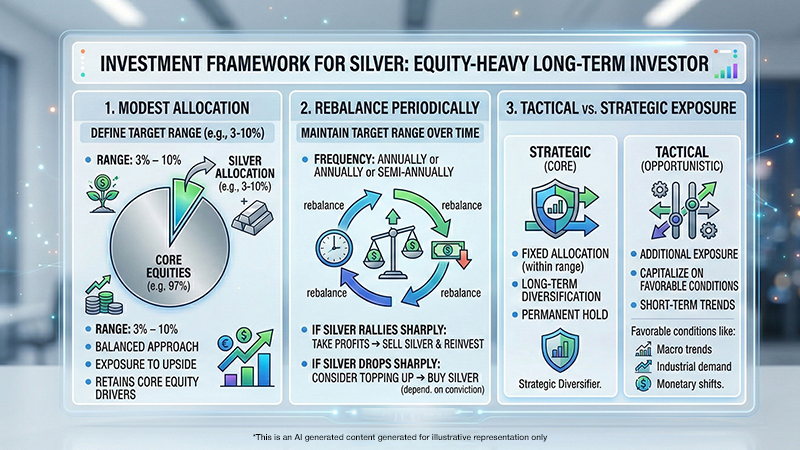
- Modest Allocation (~3–10%)
- For most investors, allocating between 3% and 10% of the portfolio to silver (via ETFs or mutual funds) is a balanced approach.
- This gives exposure to silver’s upside without over-committing capital away from core equity growth drivers.
- Rebalance Periodically
- Use periodic rebalancing (annually or semi-annually) to maintain silver within your target range.
- If silver rallies sharply, take profits to rebalance. If it drops, consider topping up, depending on conviction and long-term view.
- Use Tactical vs Strategic Exposure
- Strategic: Keep a fixed silver allocation for long-term diversification.
- Tactical: Use additional silver exposure (via ETFs/digital silver) when macro, industrial, or monetary conditions are favourable.
As we have stated in our Rebalancing blog, silver shines brightest when —added in small, intentional doses and trimmed when it overheats. That rhythm is what keeps portfolios healthy through volatile commodity cycles.
Risks, Challenges & Mitigants
It would be misleading not to acknowledge that silver investing is not without risks:
- Volatility: Silver prices can swing sharply — especially because of speculative flows and macro shifts.
- Storage & Quality Risk: For physical silver, purity, storage, and security matter.
- Liquidity: Some silver ETFs (especially in India) may have low volume, making entry/exit less efficient.
- Counterparty Risk: Derivative-based or synthetic ETFs may carry risk if counterparties default.
- Premiums & Costs: Physical silver or silver-backed products may trade at a premium depending on local supply tightness.
Mitigation Strategies:
- Use well-regulated, physically-backed ETFs or trusted digital silver platforms.
- Avoid over-concentrating; keep silver as a modest part of a diversified portfolio.
- Regularly review your silver allocation, and don’t chase short-term price spikes unless it aligns with your risk tolerance.
Many investors get caught up chasing metal rallies — a phenomenon we previously explored in “The 5-Minute Rule to Test If You’re Investing Emotionally” . Refer for a deep understanding of impulsive allocations that often undermine long-term compounding.
The Big Picture: Silver’s Role — Not as Replacement, but as Complement
As a wealth manager, I would likely be advising investors with equity-heavy portfolios for long-term growth. Silver should not replace equities or other core asset classes — but it can complement them in a few important ways:
- Diversification — By adding a non-equity, non-bond asset class, you reduce correlation risk.
- Inflation Protection — Silver offers some hedge against currency depreciation and inflation, especially over long horizons.
- Secular Trend Exposure — Silver gives indirect exposure to structural growth trends: clean energy, EVs, electronics, infrastructure.
- Tactical Opportunity — When macro conditions — such as low interest rates, weak dollar, or industrial growth — align, silver can be tactically overweighted for potential alpha.
SubhShanti Wealth’s Perspective: A Grounded Way to Think About Silver
At SubhShanti Wealth, we introduce silver with context, balance, and focus on the investor’s needs instead of focusing on the headlines.
- We bring clarity before action. Silver is introduced only after understanding your goals, timelines, and risk tolerance — not because of market noise.
- We ensure your foundation is solid. Emergency corpus, insurance, debt, and core equity come first. Only then do we help assess whether silver adds strength to your long-term plan.
- We guide you to the right allocation. A balanced 3–10% exposure is usually enough. SubhShanti helps determine the right level for your profile, not a generic number.
- We favour structure over sentiment. Decisions are made through rule-based frameworks using SEBI-regulated ETFs or FoFs, keeping your exposure transparent and disciplined.
- We keep your portfolio honest with rebalancing. When silver moves sharply, we help you trim, hold, or top up based on your plan — never on impulse.
- We position silver more as a tool than a headline. Our role is to ensure every element in your portfolio, including silver, is intentional and aligned with the life you’re building.
Key Take-Home Messages for the Readers
All information reflects publicly available data and credible market research as of November 2025.
- Silver is no longer just “poor man’s gold”: it’s a strategic metal with growing industrial relevance.
- Rising demand from solar PV, EVs, electronics, and infrastructure — coupled with limited supply — is providing strong tailwinds.
- Investment vehicles like ETFs, mutual fund FoFs, and digital silver make it easy for retail investors to gain exposure.
- But silver is volatile. For most investors, a modest allocation (3–10%) is wise, complemented by rebalancing.
- Silver should be viewed as a complement to, not a substitute for, long-term equity investments.
Disclaimer
This article is intended solely for educational and informational purposes. It does not constitute investment advice, trading recommendations, or a solicitation to buy or sell any securities or financial instruments. The views expressed are based on publicly available data, regulatory studies, and industry observations, including reports published by the Securities and Exchange Board of India (SEBI). Readers are advised to assess their financial objectives, risk appetite, and suitability before making any investment or trading decisions. Derivatives trading, including Futures & Options (F&O), involves substantial risk and may not be suitable for all investors. Past performance is not indicative of future results. Investors should consult a SEBI-registered investment adviser or other qualified financial professional before acting on any information presented herein.