

The phrase “consumption is India’s new growth engine” has become more than just an economist’s talking point—it’s a tangible reality reshaping wealth opportunities in ways we haven’t seen in a generation. If you’ve been watching the Indian economy evolve, you’ll notice something profound happening beneath the surface: consumption-driven growth isn’t a future scenario anymore; it’s happening right now, and it’s rewriting the playbook for how investors should think about their portfolios.
For those who remember the early 2000s, India’s growth story was primarily built on services and IT exports. Today, the narrative has fundamentally shifted. What we’re witnessing is an unprecedented consumption boom driven by favorable demographics, rising incomes, and a young, aspirational population that’s redefining what it means to be Indian consumers. This isn’t just good news for businesses—it’s a game-changing opportunity for investors who understand the nuances of this transformation.
Why Consumption Matters More Than Ever
Let’s start with numbers, because they tell a compelling story. India’s private consumption now accounts for approximately 56% of GDP, making it the single largest driver of economic growth. To put this in perspective, think about the equation: GDP = C + G + I + NX (where C is consumption, G is government spending, I is investment, and NX is net exports). Consumption is the heavyweight in this formula, and that concentration of economic power creates profound investment implications.
Over the past decade, private consumption expenditure has grown at a compound annual growth rate (CAGR) of approximately 6%, reflecting consistent consumer confidence and economic resilience. This is noteworthy because it shows that Indian consumers aren’t just spending—they’re spending with conviction, which speaks to deeper structural improvements in income levels, employment, and purchasing power.
But here’s where it gets interesting: India’s consumption landscape isn’t uniform. The top 10% of consumers contribute 67% of discretionary spending, while they represent just 10% of the population. This Pareto distribution reveals a critical insight—there’s massive room for growth as the middle class expands and more people move into higher consumption brackets. India is projected to become a $5 trillion consumption economy by 2031, driven primarily by the fast-growing middle class with rising incomes.
The Demographics Advantage: Why Timing Matters
One of the most underappreciated factors in India’s consumption story is demographics. While much of the developed world and even China face aging populations, India is in a unique position. By 2030, the median age in India will be just 31 years—compared to 40 in the US and 42 in China. This means India will remain one of the youngest nations globally, with one of the largest working-age populations.
Here’s the critical part: 77% of India’s population is expected to comprise Millennials and Gen Z by 2030. These aren’t passive consumers passively inheriting traditional spending patterns. They’re digitally native, aspirational, and actively redefining consumption categories. They’re choosing e-commerce over traditional retail, quick commerce over planned shopping, and OTT platforms over cable television. They’re buying Teslas instead of conventional cars (metaphorically, for now), choosing experiences like live events over television, and shifting food preferences toward health-conscious and ready-to-eat options.
The workforce dynamics amplify this advantage further. India is set to add 859 million people to its working population between 2023 and 2050, compared to -238 million for China and -19 million for the US. This means 1 in every 5 working people globally by 2050 is projected to be Indian. Young, employed Indians drive spending, and this is a demographic tailwind that will persist for decades.
Urban Expansion: The Next Wave
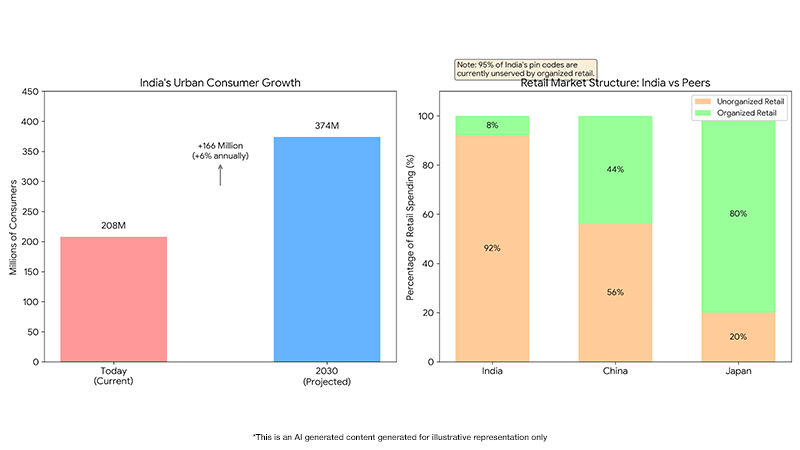
The urbanization story in India is often discussed, but its investment implications deserve deeper consideration. Today, India has approximately 208 million urban consumers, growing at 6% annually. By 2030, this is projected to reach 374 million—an addition of 166 million consumers. To contextualize this: the growth of India’s urban consumer class alone is 7 times larger (in percentage terms) than global population growth and almost double the growth of the global consumer class.
This urbanization creates a ripple effect. Urban consumers have higher disposable incomes, greater exposure to new products and services, and stronger purchasing power. But more importantly, they drive formal consumption through organized retail, e-commerce, and modern services—sectors that offer clearer investment opportunities with better margins and scalability.
Speaking of organized retail, here’s a striking statistic: 92% of retail spending in India still flows to unorganized players, compared to just 56% in China and 20% in Japan. This suggests that India’s organized retail sector is still in its infancy, presenting a massive growth runway. Currently, 95% of pin codes in India are still unserved by organized retail. This isn’t a problem—it’s an opportunity. As organized retail penetrates tier-2 and tier-3 cities, investors positioned in this space stand to capture enormous value creation.
The Generational Shift: How Consumption Patterns Are Evolving
One of the most fascinating aspects of India’s consumption story is how consumption preferences themselves are transforming. Consider this: Baby Boomers bought Ford Mustangs and listened to music on audio cassettes. Gen X transitioned to personal computers and Walkmans. Millennials embraced smartphones and e-commerce. Gen Z is now driving demand for nano-computing, quick commerce, and digital entertainment.
But this isn’t just about gadgets—it’s about entire sectors being redefined. Traditional FMCG is evolving as consumers increasingly seek health-conscious food options. Automobile consumption is shifting toward electric vehicles and shared mobility. Entertainment is fragmenting across digital platforms, gaming, and live events, rather than concentrating in television.
Here’s what matters for investors: sectors that align with Gen Z and Millennial preferences—digital entertainment, quick commerce, organized retail, automotive innovation, health-conscious FMCG, and consumer services—are positioned to capture disproportionate growth. These aren’t niche segments; they’re becoming the mainstream.
Government Support: The Tailwind Behind Consumption
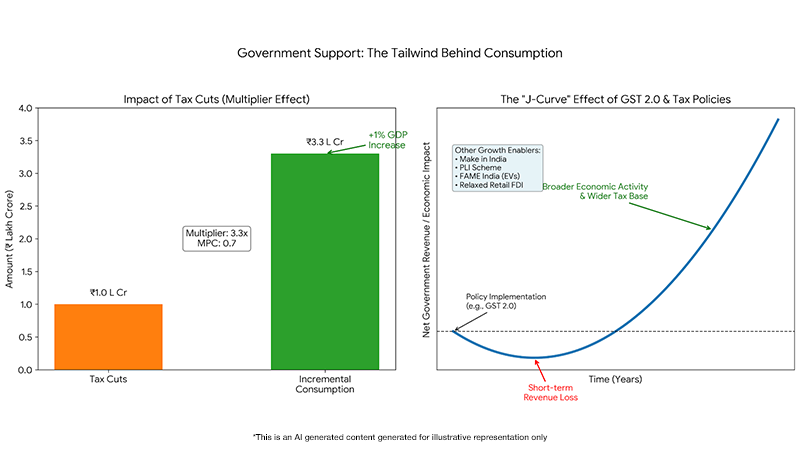
Investors often overlook the role of government policy in creating consumption tailwinds. Recently, India implemented tax cuts worth ₹1 lakh crore, which are expected to drive incremental consumption of ₹3.3 lakh crore—a multiplier effect of approximately 3.3x. Based on the marginal propensity to consume (MPC) of 0.7, this cascading effect translates to a potential 1% increase in GDP.
Additionally, the government’s recent GST rate reductions (GST 2.0, that has been effective since September 22, 2025) signal a clear commitment to boosting domestic consumption as a hedge against global economic uncertainties. The government is explicitly betting on a “J-curve effect”—accepting short-term revenue losses in exchange for broader economic activity and a wider tax base. This policy environment creates a favorable backdrop for consumption-driven growth over the next 3-5 years.
Beyond tax policy, government initiatives like Make in India, the Production-Linked Incentive (PLI) Scheme, the FAME India Scheme for electric vehicles, and relaxed foreign direct investment rules for retail are actively building infrastructure for consumption growth. These aren’t passive measures; they’re actively shaping which sectors capture value in the consumption wave.
The Investment Case: Why Consumption Matters for Your Portfolio
Now, let’s get to the heart of why this matters for your wealth. Consumption-driven growth offers something precious to investors: visibility and resilience. Unlike cyclical sectors that depend on global demand or capital expenditure cycles, consumption-linked businesses benefit from structural tailwinds. Rising incomes, favorable demographics, and policy support create a durable growth environment.
Consider the data: private consumption in India has grown consistently, even during downturns. Consumer resilience, according to global surveys, is 83% driven by micro factors (personal income changes, job security) and only 17% by macro factors (recession, geopolitical concerns). This means Indian consumer spending is grounded in real income growth rather than fragile macro conditions—a crucial distinction for long-term investors.
The sectors benefiting from this consumption wave are diverse: fast-moving consumer goods (FMCG), consumer durables, automobiles, retail, consumer services, and the emerging segments of digital entertainment, gaming, and quick commerce. This diversification means you’re not betting on a single narrative but on a broad economic transformation.
Identifying long-term themes is only half the equation; converting them into resilient portfolios requires disciplined planning, risk alignment, and behavioural oversight—principles explored in 5 Ways Wealth Experts Can Help Secure Your Financial Future.
From China’s Playbook to India’s Opportunity
There’s a valuable historical parallel to consider. When China’s per capita income crossed 2,000 dollars in 2006, it signaled the start of a decade-long economic surge—growing almost fourfold to over 8,000 dollars by 2016. India crossed that same 2,000-dollar mark in 2019, suggesting that the next decade could mirror a similar phase of rapid income expansion, potentially taking India’s per capita income beyond 8,000 dollars before 2030.
But the foundation of India’s growth story is fundamentally different. China’s rise was export-led—its economy thrived on manufacturing scale, global demand, and trade surpluses. India’s expansion, by contrast, is being powered from within. Urbanization, rising disposable incomes, a young working population, and digital access are fueling domestic consumption across sectors—from financial services to discretionary spending and healthcare.
This inward growth model makes India more insulated from external shocks like trade restrictions or global demand slowdowns. It also creates a deeper and more sustainable base for long-term investors, as the drivers of growth—consumers—are within India’s borders. In short, while China’s growth was built on exporting to the world, India’s opportunity lies in selling to itself.
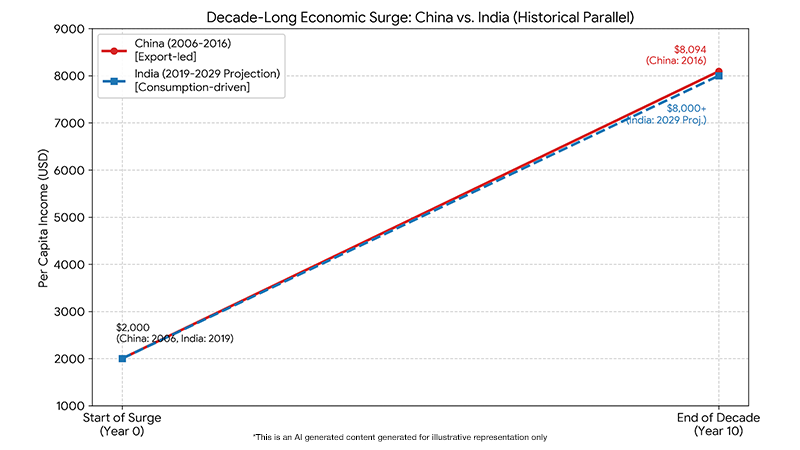
Here’s a clear comparison table highlighting the key differences between China’s and India’s growth models, focusing on what sets India’s consumption story apart:
| Aspect | China (2006–2016) | India (2019–2029 Projection) |
| Growth Trigger | Export-led manufacturing | Domestic consumption-driven |
| Per Capita Income Jump | $2,000 → $8,094 | $2,000 → $8,000+ (projected) |
| Main Economic Driver | Global demand, exports | Internal demand, rising middle class |
| Resilience to Trade Shocks | Low (global exposure) | High (insulated by domestic focus) |
| Sectors Leading Growth | Manufacturing, exports | Services, consumption (FMCG, finance, retail) |
| Policy Focus | Export incentives, trade deals | Consumption, digitalization, social welfare |
| Investor Implication | Voltile, cyclical | Stable, broad-based opportunities |
This table makes it easy to see how India’s internal consumption-driven economy creates unique and resilient opportunities for investors compared to China’s export-led past.
What To Watch: Key Indicators for Consumption Growth
As you evaluate your own investment opportunities, keep these metrics on your radar:
Urban consumer growth: Track the expansion of urban consumer numbers. If India adds consumers at the projected 6% annual rate, consumption businesses will expand their addressable markets consistently.
Discretionary spending patterns: Monitor how the middle class (which contributes 23% of discretionary spending) evolves. As their numbers grow and incomes rise, consumption companies will see accelerating growth.
Organized retail penetration: Watch for progress in organizing India’s retail sector. Every percentage point shifts from unorganized to organized retail benefits listed companies in the space.
Policy environment: Track tax policies, GST rates, and sector-specific incentives (like the PLI scheme). Favorable policy creates tailwinds that amplify consumption growth.
Income growth: Ultimately, consumption is constrained by income. Monitor wage growth, employment trends, and income levels in urban areas. Rising real incomes sustain consumption growth.
As consumption-linked growth broadens across sectors, investors often explore complementary exposures beyond traditional equities—a complexity addressed in Top Alternative Investments in High-Net-Worth Portfolios.
How SubhShanti Wealth Guides You Through This Wave
In an era where India’s consumption story is rewriting the rules of opportunity, SubhShanti Wealth helps you do more than merely participate. It positions you to convert this structural tailwind into durable, generational wealth—built with discipline, guided by expertise, and strengthened through an endurings partnership.
To make that journey seamless, strategic, and future-proof, SubhShanti Wealth brings together a suite of integrated services:
- Consumption-Aligned Investment Strategy
Spotting sectors and businesses riding the consumption wave and embedding them into a disciplined, long-term portfolio architecture. - Holistic Financial Planning
Aligning investments, cash flows, aspirations, and risk—ensuring your financial life functions as one coherent ecosystem. - Tailored Solutions Across Life Stages
Designing customised frameworks for early investors, mid-career wealth builders, and individuals nearing retirement. - Balanced Asset Allocation
Blending growth-oriented opportunities with protection, liquidity, and tax efficiency, so ambition and resilience coexist. - Research-Backed Insights & Regular Reviews
Fine-tuning your strategy with consistent updates, timely data, and ongoing review cycles that keep you ahead of changing market currents. - 1:1 Expert Meet & Ongoing Partnership
Offering continuous, personalised support—ensuring you’re never navigating financial complexities in isolation. - Risk Management & Downside Protection
Helping your portfolio participate in upcycles while reducing unnecessary exposure to volatility. - Cash Flow & Liquidity Structuring
Organising your finances to deliver stability today, adaptability tomorrow, and readiness for every opportunity that emerges.
The Bottom Line
India stands at an inflection point. The convergence of favorable demographics, rising incomes, government support, and evolving consumer preferences has created a once-in-a-generation opportunity in consumption-driven growth. This isn’t speculation—it’s built on structural, long-term trends that will persist regardless of short-term market noise.
For investors, the opportunity is clear: position your portfolio to benefit from India’s consumption wave. But doing so effectively requires more than identifying trends; it demands understanding the specific opportunities within those trends and constructing portfolios aligned with your goals.
SubhShanti Wealth’s role in this journey is to serve as your trusted partner through India’s consumption transformation—providing research, education, and personalized guidance that helps you build lasting wealth. The wave is building; the question isn’t whether you’ll notice it, but whether you’ll position yourself to ride it.
The consumption story in India isn’t a bulletin—it’s a movement that will shape the next decade of wealth creation. The question isn’t “Is consumption growth real?” The evidence is overwhelming. The real question is: “Are you positioned to benefit from it?”
Ready to explore how India’s consumption growth can enhance your investment strategy? Reach out to SubhShanti Wealth to discover how you can align your portfolio with this transformational opportunity.