
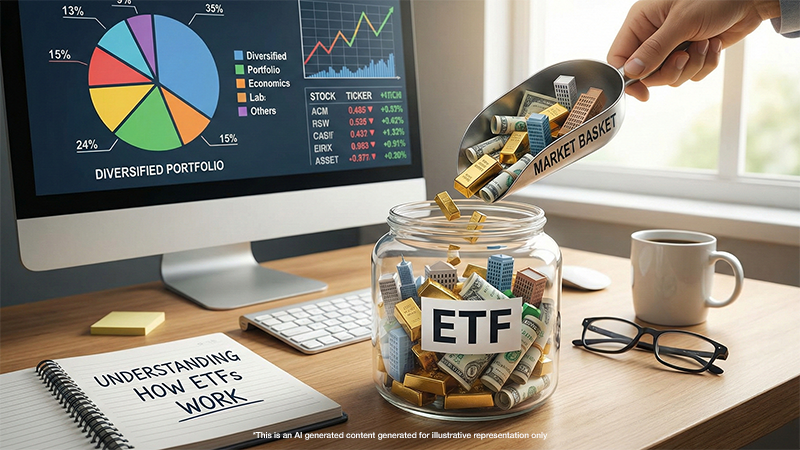
Exchange-Traded Funds (ETFs) sit at the intersection of innovation and practicality. They were born out of a simple question: How do we give investors the breadth of a diversified portfolio with the ease of buying a single stock? Three decades later, ETFs have become one of the fastest-growing investment instruments globally—powered by transparency, low cost, and an indexing revolution.
In India, the momentum is unmistakable. From equity to gold to debt, ETFs are emerging as the quiet workhorses of modern portfolios. To use them efficiently, you need to understand not just what they are, but how they function.
Let’s walk through it.
What Exactly is an ETF? A Modern Investing Shortcut
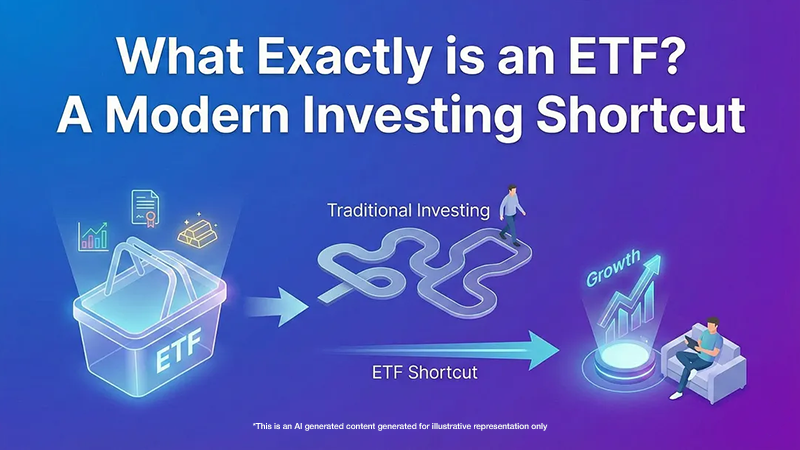
An Exchange Traded Fund (ETF) is a pooled investment vehicle that tracks a specific index, commodity, or basket of securities. It combines:
• The diversification of mutual funds
• The real-time tradability of stocks
When you buy an ETF, you’re essentially becoming a co-owner of an entire portfolio whether that’s the Nifty 50, a corporate bond index, or even gold.
This structure makes ETFs practically efficient for investors who want broad exposure with minimal friction.
How ETFs Actually Work
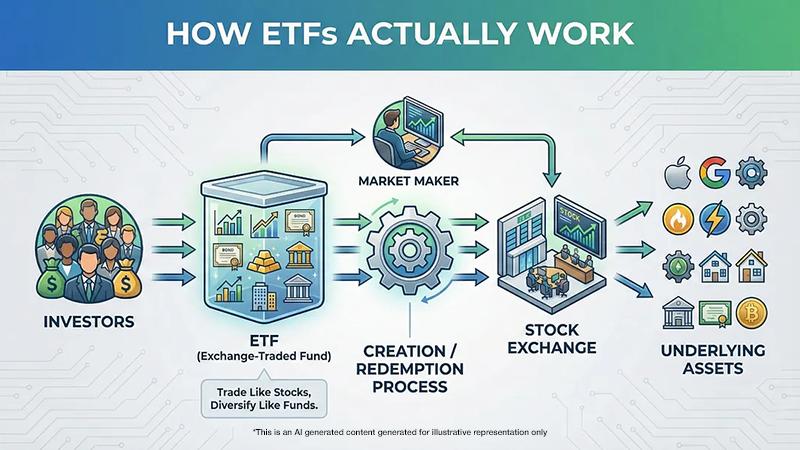
Behind the scenes, ETFs operate on a creation–redemption mechanism managed by:
Authorised Participants (APs) & Market Makers
These institutions ensure liquidity and keep the ETF price aligned with its NAV.
Imagine the ETF as a basket of apples (stocks). If the basket becomes too expensive relative to the apples, APs buy apples, create new baskets, and sell them, bringing the price back in line. If the basket becomes too cheap, they do the opposite.
This ecosystem ensures:
• Low cost
• Low tracking error
• High liquidity
• Minimal price distortions
That’s why ETFs are globally celebrated for their structural integrity.
Types of ETFs You’ll Commonly See in India
| ETF Type | What It Tracks / Offers | Purpose |
| Equity ETFs | Track indices like Nifty 50, Sensex, Nifty Next 50, or global benchmarks. | Long-term compounding, equity market participation. |
| Debt ETFs | Bharat Bond ETFs, PSU bond ETFs, short-duration debt indices. | Stability, predictable income profiles, lower volatility. |
| Gold ETFs | Demat-based exposure to live gold prices without holding physical gold. | Inflation hedge, crisis-time stability, portfolio diversification. |
| Factor ETFs | Systematic strategies such as Value, Momentum, Low Volatility, Quality. | Rule-based investing with potential to enhance returns or reduce risk. |
| Thematic ETFs | Sector or theme-based: Banking, IT, ESG, innovation, clean energy, global trends. | Tactical allocation, exposure to long-term structural themes. |
Why ETFs Matter: The Real World Benefits
You don’t need to be a market wizard to appreciate what an ETF brings to the table.
1. Low Cost, High Efficiency
ETFs generally cost 40–90% less than active funds. This cost difference compounds into meaningful wealth over long horizons.
2. Daily Transparency
You can see the holdings every day. That’s rare clarity in a world where financial products often hide behind complexity.
3. Market-Like Flexibility
Buy or sell anytime during market hours. Use limit orders. Set your price. Stay in control.
4. Diversification Built-In
One ETF can give exposure to an entire index of 50, 100, or even 500 companies.
5. Lower Human Bias
No fund manager bets. No emotional calls. Pure index tracking.
6. Great for Long-Term Discipline
ETFs make the investing process about discipline—and boring is often profitable.
But before you choose an ETF… understand your psychology, you can refer to our other blog: The 5-Minute Rule to Test If You’re Investing Emotionally
Understanding your emotional patterns will help you select ETFs, and stick with them, without reacting to noise. It’s a perfect complement to index-based investing.
ETFs Through India’s Big Market Moments
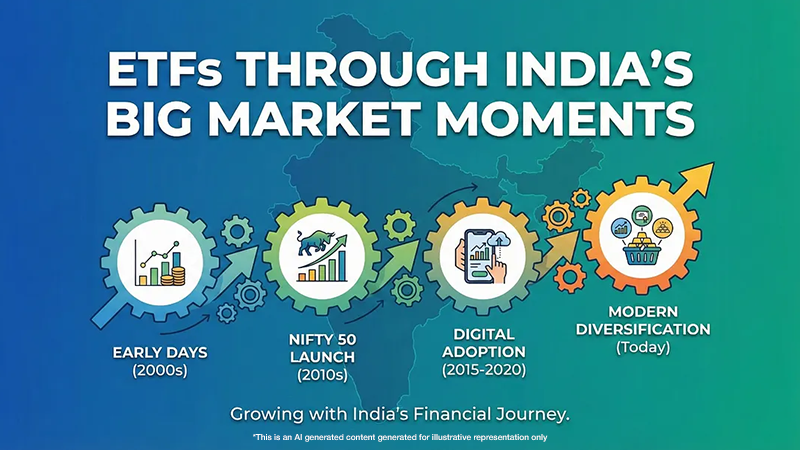
Proof how ETFs held up:
- 2020 COVID Crash: Nifty ETF fell 38%, recovered 100% in 18 months (faster than many active funds).
- 2022 Rate Hikes: Debt ETFs dipped 2–4% vs. 15%+ for some bonds—stability win.
- Gold Surge 2023–25: Gold ETFs returned 18% annually, beating fixed deposits.
ETFs shine in chaos because they mirror reality, not chase hype.
Source: Economic Times
Watch Out: Common Traps and How to Dodge Them
Even simple tools have gotchas. Here’s what to avoid:
- Chasing hot themes: That “AI boom” ETF might soar then crash—stick to broad indexes for safety.
- Ignoring the gap: If an ETF’s price drifts far from its basket value, it’s a red flag for poor quality.
- No Demat? No go: ETFs need one; mutual funds don’t.
- Taxes simplified: Stock ETFs get favorable long-term rates (over 1 year); gold ones skip gold’s extra charges.
- SIP workaround: No direct monthly plans, but broker automation works fine.
How SubhShanti Wealth Helps You Use ETFs the Right Way
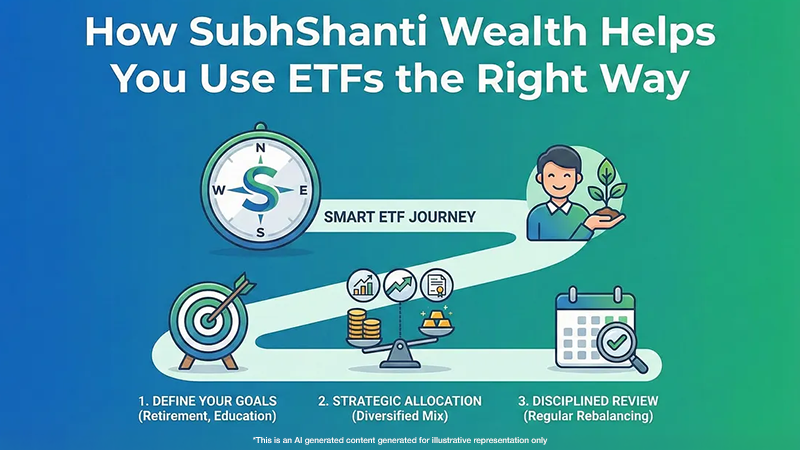
SubhShanti Wealth brings the discipline of research, the clarity of long-term planning, and the precision of goal-based investing.
Here’s where the expertise comes in:
• Identifying the right ETFs for your goals
Not every ETF is liquid, well-managed, or efficient. The difference between a high-quality ETF and a mediocre one directly affects outcomes.
• Creating intelligent asset allocation
Equity ETFs alone are not a plan. Balancing equity, debt, and gold ETFs can create a resilient, inflation-beating strategy.
• Monitoring tracking errors and liquidity
Two things often overlooked by DIY investors but critical for long-term efficiency.
• Integrating ETFs into your financial roadmap
ETFs are tools. SubhShanti Wealth ensures they’re used with intention, not excitement.
• Ensuring compliant, client-first, research-backed advice
With a decade-plus track record and global investors, SubhShanti Wealth stays aligned with AMFI norms and ethical clarity.
Expert-led clarity + ETF simplicity = long-term stability.
If you want to know what else mutual funds can do for you, refer to our Things you didn’t know Mutual Fund Could do, (But they can) blog.
FAQs
1. Are ETFs better than mutual funds?
Different tools for different needs. ETFs offer low cost and transparency; active funds aim to outperform markets but may not always succeed.
2. Can I SIP into ETFs?
Not directly. But you can automate monthly purchases through your broker, achieving the same effect.
3. Are ETFs tax-efficient?
Equity ETFs enjoy equity taxation—favourable for long-term investors. Gold ETFs avoid GST and making charges.
4. How important is tracking error?
Very. Lower tracking error means the ETF mirrors the index more accurately. High tracking error erodes returns subtly over time.
5. Do I need a Demat account?
Yes, unlike mutual funds, ETFs are held in Demat form.
Final Takeaway
ETFs are not designed to thrill you, they’re built to serve you instead.
They’re disciplined, transparent, low-cost engines for long-term wealth creation.
If you want a strategy that:
• avoids unnecessary complexity,
• aligns with your long-term goals,
• remains stable even when markets get noisy, then ETFs deserve a place in your portfolio.
SubhShanti Wealth can help you identify the right ETFs, structure your asset allocation, and stay consistent year after year—because good investing isn’t about finding the next big thing, it’s about staying committed to the right things.
Disclaimer
This article is intended solely for educational and informational purposes. It does not constitute investment advice, trading recommendations, or a solicitation to buy or sell any securities or financial instruments. The views expressed are based on publicly available data, regulatory studies, and industry observations, including reports published by the Securities and Exchange Board of India (SEBI). Readers are advised to assess their financial objectives, risk appetite, and suitability before making any investment or trading decisions. Derivatives trading, including Futures & Options (F&O), involves substantial risk and may not be suitable for all investors. Past performance is not indicative of future results. Investors should consult a SEBI-registered investment adviser or other qualified financial professional before acting on any information presented herein.