

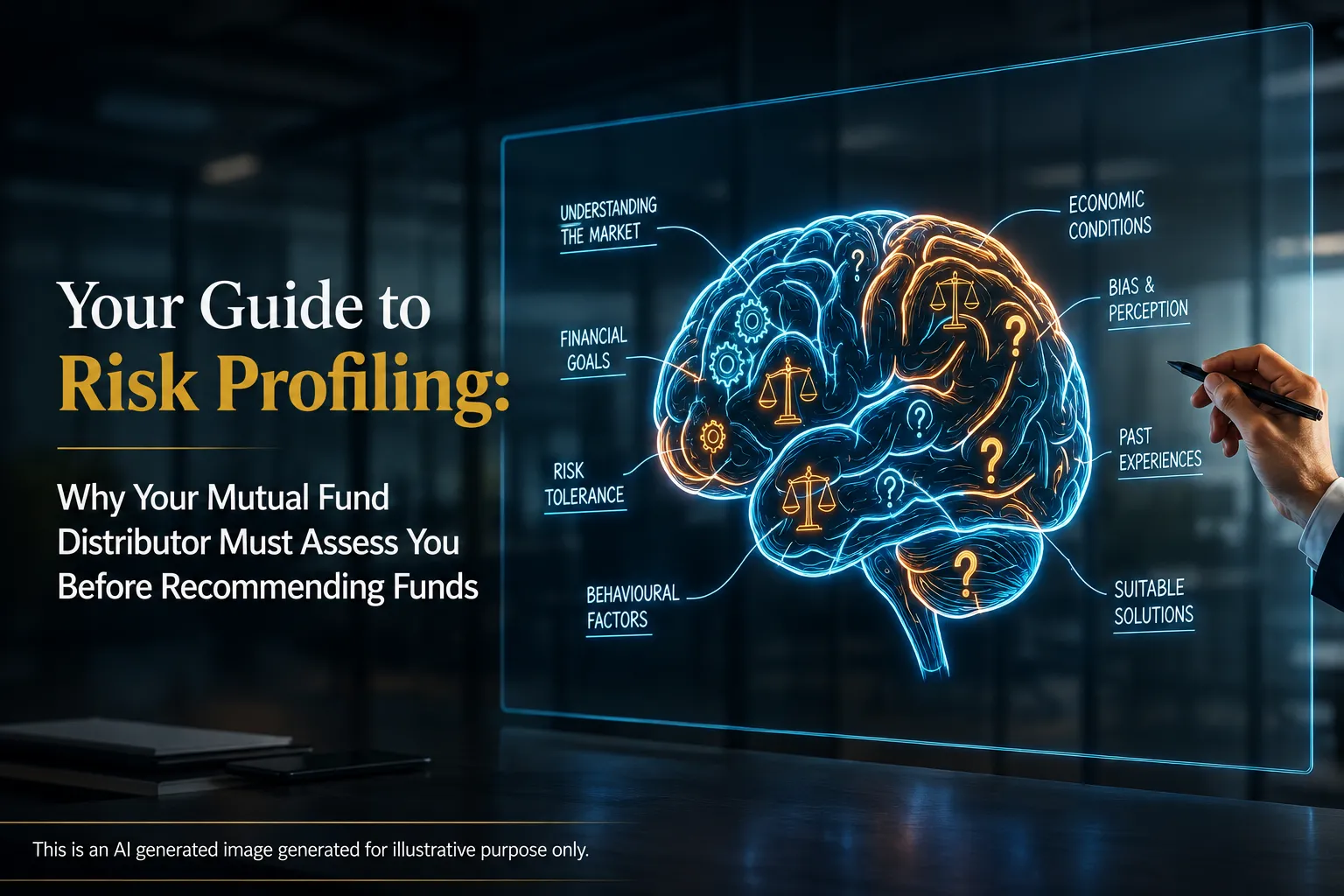
Imagine walking into a pharmacy and asking the pharmacist for the “best-selling medicine of the year.” The pharmacist would likely refuse to sell it to you without first understanding your symptoms, your medical history, and your allergies. What cures one person could be disastrous for another.
The financial markets operate on the exact same principle. With thousands of mutual fund schemes available in India today, investors are constantly bombarded with too much information. Business news channels highlight the “best performing small-cap fund,” while colleagues boast about their double-digit returns in sector-specific funds. This creates an overwhelming temptation to chase the “flavour of the season.”
However, professional wealth management is not about chasing yesterday’s winners. At SubhShanti Wealth, we know that successful, stress-free investing is grounded in a deep, scientific understanding of the investor. The single most critical step a Mutual Fund Distributor (MFD) must take before ever suggesting a specific mutual fund is determining your risk profile.
In this comprehensive guide, we will break down the psychology and mathematics of how to know your risk appetite. We will analyze the aggressive vs conservative investor, examine how time horizon and income shape your financial destiny, and reveal why a proper MFD uses this data to protect you from your own behavioral biases.
The Anatomy of Risk Profiling (Beyond “High vs. Low”)
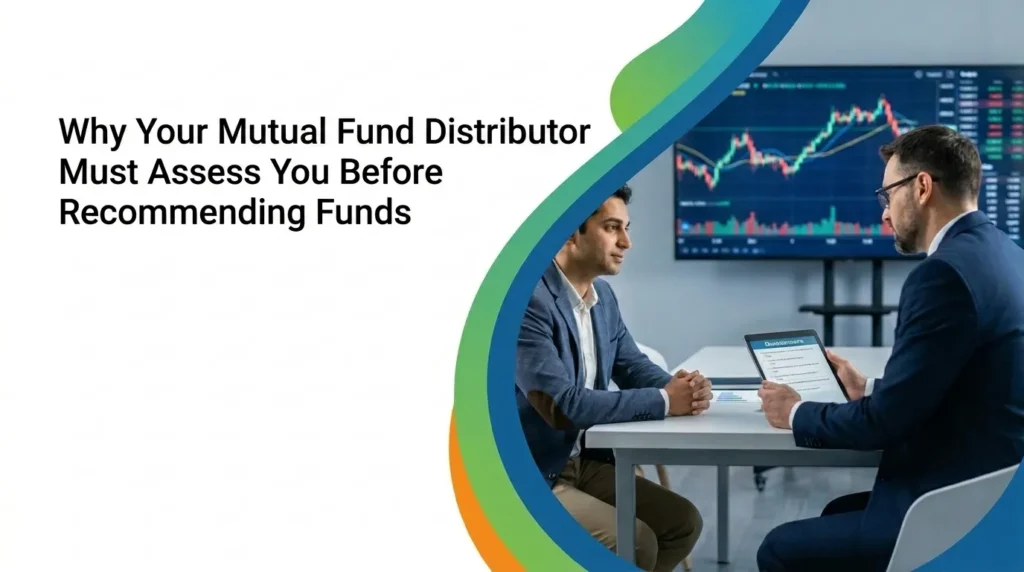
Risk profiling is frequently misunderstood. Many investors believe it simply involves filling out a form that asks, “Are you okay with losing money?” Naturally, human instinct screams “No,” leading to skewed results.
In reality, risk profiling is a sophisticated evaluation of your ability, willingness, and absolute need to take financial risks. According to the principles of financial planning and Modern Portfolio Theory (pioneered by Nobel laureate Harry Markowitz), a true risk profile is the intersection of three distinct pillars:
1. Risk Need (The Mathematical Requirement)
Your “Risk Need” is purely objective. It calculates the rate of return required to achieve your life goals based on the capital you currently have and the amount you can save.
- The Reality Check: If you are 45 years old, have minimal retirement savings, and require a Rs. 5 Crore corpus by age 60 to maintain your lifestyle, mathematics dictates that a 6% return from a traditional bank Fixed Deposit will fail you. You need to take on the risk of equity markets to aim for a 12-14% annualized return.
2. Risk Capacity (The Financial Ability)
Risk capacity evaluates your financial foundation to withstand sudden market shocks. It has nothing to do with your emotions and everything to do with your balance sheet.
- High Capacity: An investor with a highly secure job, zero debt, comprehensive health insurance, and a fully funded emergency cash reserve has an incredibly high capacity for risk. If the stock market drops 30% tomorrow, their daily lifestyle remains completely unaffected.
- Low Capacity: A freelance consultant with fluctuating monthly income, an expensive home loan EMI, and aging dependents has a very low risk capacity. They cannot afford temporary capital erosion because an emergency might force them to withdraw their investments at a massive loss.
3. Risk Tolerance (The Psychological Willingness)
This is the behavioral aspect of investing. It measures your emotional comfort with market volatility.
- The Emotional Mismatch: Often, an investor has a high capacity and need for risk, but a critically low tolerance. They might panic and lose sleep over a 5% portfolio drop. A professional MFD bridges this gap through education, behavioral coaching, and careful asset allocation, ensuring the investor doesn’t abandon their strategy during a routine market correction.
The 5 Investor Risk Profiles Explained in Depth
The financial advisory industry categorizes investors into five distinct profiles. These are not arbitrary labels; they are architectural blueprints that dictate how your wealth should be distributed across Equity (stocks), Debt (bonds), and alternative assets (like Gold).
1. The Very Conservative Investor: The Fortress Builder
- The Core Mindset: Capital preservation is the absolute, non-negotiable priority. This investor views the stock market as highly unpredictable and prefers absolute certainty, even if it means losing purchasing power to inflation over time.
- The Typical Persona: Retirees drawing a monthly income to cover living expenses, or individuals saving for an immediate goal (like buying a house in six months or paying a child’s upcoming college tuition).
- Market Behavior: During the 2008 global financial crisis or the 2020 pandemic crash, a very conservative portfolio barely fluctuated, providing the investor with immense peace of mind.
- Portfolio Architecture: 80% to 100% in pure Debt instruments. This includes Liquid Mutual Funds, Overnight Funds, Bank Fixed Deposits, and high-quality Corporate Bond Funds. Equity exposure is strictly avoided.
2. The Conservative Investor: The Inflation Fighter
- The Core Mindset: “I want my money to be safe, but I understand that inflation is a tax that eats away my wealth. I need my money to grow slightly faster than inflation, but I cannot tolerate large, sudden drops in my portfolio value.”
- The Typical Persona: Investors nearing retirement (within 3 to 5 years) or conservative savers looking to build a secure nest egg without experiencing heart palpitations when they watch the business news.
- Portfolio Architecture: 70% to 85% in Debt Funds (for stability and regular income generation), paired with 15% to 30% in Equity. The equity portion strictly avoids volatile small-cap companies, focusing instead on Large-Cap Index funds or Conservative Hybrid Funds, which offer a gentle, cushioned entry into the stock market.
3. The Moderate Investor: The Balanced Strategist
- The Core Mindset: “I want to build long-term wealth and beat inflation comprehensively. I understand that markets will fluctuate, but I want a strong shock absorber in my portfolio so that a market crash doesn’t wipe out my progress.”
- The Typical Persona: Middle-aged professionals, dual-income families, and individuals saving for medium-to-long-term goals (7-10 years) such as a child’s higher education or building a house.
- Portfolio Architecture: Typically a 50/50 or 60/40 split between Equity and Debt. This profile heavily relies on Balanced Advantage Funds (BAFs) or Multi-Asset Allocation funds. These intelligent funds dynamically adjust their equity and debt exposure based on market valuations buying equities when they are cheap and moving to debt when equities become expensive doing the heavy lifting of risk management for the investor.
4. The Aggressive Investor: The Wealth Creator
- The Core Mindset: “I am investing for the long haul. Short-term volatility is just background noise to me. I am perfectly comfortable seeing my portfolio drop 10% in a bad year, because I trust the long-term compounding power of the Indian economy.”
- The Typical Persona: Young professionals in their 20s and 30s with stable, growing incomes, decades left until retirement, and a strong appetite for wealth accumulation.
- Portfolio Architecture: 75% to 85% in Equity, with only 15% to 25% in Debt (primarily kept for portfolio rebalancing and sudden emergencies). The equity portion is diversified broadly across Large-Cap, Mid-Cap, and Flexi-Cap mutual funds, capturing growth across all sectors.
5. The Very Aggressive Investor: The Apex Growth Seeker
- The Core Mindset: “Maximize returns at all costs. I understand market cycles deeply. A market crash is not a risk; it is a massive buying opportunity. I have the time, the capital, and the iron stomach to weather extreme financial storms.”
- The Typical Persona: High-net-worth individuals, seasoned investors who have lived through multiple market cycles, or young individuals with massive disposable income and zero financial dependents.
- Portfolio Architecture: 90% to 100% Equity. This portfolio takes calculated, concentrated bets on highly volatile segments: Small-Cap funds, Mid-Cap funds, Sectoral/Thematic funds (like IT, Pharma, or Infrastructure), and international equities.
How Time Horizon Dictates Your Financial Destiny
Most online searches for “how to determine my risk appetite” lead to emotion-based quizzes. We have developed a unique questionnaire centered on daily habits that uncover deeper insights than mere feelings.
Discover your actual risk capacity by taking our specialized assessment here: [Insert Link]
At SubhShanti Wealth, we focus on the objective, unchangeable realities that physically restrict or expand your risk appetite. The most powerful of these is your Time Horizon.
Time is the ultimate risk-mitigation tool in investing. In the short term, the stock market is a voting machine driven by human emotion and panic. In the long term, it is a weighing machine driven by corporate earnings and economic growth. Therefore, the length of time you can keep your money invested dictates your true risk capacity.
Volatility Risk vs. Inflation Risk
Understanding these two distinct risks is what separates amateur investors from professionals.
- If you invest for 1 to 3 years: Your biggest enemy is Volatility Risk. This is the risk that the market crashes right before you need to withdraw your money to buy a car or pay a down payment. You do not have the time to wait for the market to recover. Therefore, your risk capacity is Conservative.
- If you invest for 15 to 20 years: Your biggest enemy is Inflation Risk. This is the risk that “safe” investments like savings accounts fail to keep up with the rising cost of living, making you poorer in terms of purchasing power. Here, you must take on Volatility Risk to defeat Inflation Risk. For a deeper dive into this, check out our guide: Beyond the 6%: Reassessing Wealth Preservation in an Era of Persistent Inflation
The Danger of “Sequence of Returns Risk”
For retirees, the time horizon brings a unique danger called the Sequence of Returns Risk. If you retire and experience severe market correction in the first two years of your retirement, and you are withdrawing money to live on, you are selling your mutual fund units at deeply discounted prices. You will deplete your wealth rapidly, even if the market recovers later.
This is exactly why an MFD forces a shift from an Aggressive profile to a Conservative profile as you get closer to your goal.
Income, Liabilities, and Your Risk Anchor
While the time horizon is your sail, your cash flow is your anchor. Your daily financial reality determines your psychological fortitude when the markets inevitably turn red.
The Stability Factor:
Consider two investors, both 30 years old, saving for retirement at age 60. By the rule of time horizon alone, both should be Aggressive investors. But their incomes tell a different story.
- Investor A is a senior software engineer with a rock-solid monthly salary, a working spouse, and a fully stocked emergency fund. When their mutual fund portfolio drops by 20%, they do not panic because their daily life paying rent, buying groceries, and paying school fees is fully covered. They can afford to be aggressive.
- Investor B is a freelance designer. Their income is highly unpredictable. They have an expensive car loan and are the sole earner for their parents. If the market crashes and they face a sudden medical emergency, they might be forced to sell their mutual funds at a massive loss just to survive. Their capacity naturally limits them to a Moderate or Conservative profile, despite their young age.
Your MFD must ask hard questions about your debts, your job security, and your dependents etc. before classifying your risk. Learn more about how your strategy should adapt over time in our Age wise guide in mutual fund investing in unpredictable markets.
The Behavioral Biases Blocking Your Wealth
Why is self-assessing your risk profile so dangerous? Why can’t you just use an online calculator and pick funds yourself?
Because the human brain is hardwired with psychological biases that make us terrible at judging our own risk tolerance. According to groundbreaking research in behavioral finance (much of it pioneered by Nobel laureate Daniel Kahneman), investors consistently make irrational decisions when real money is on the line.
A skilled MFD understands these biases and acts as a behavioral coach to protect you from your own instincts.
1. Recency Bias
Recency bias is the human tendency to believe that whatever happened recently will continue happening forever.
- The Danger: In a raging bull market, investors suffer from acute recency bias. They see small-cap mutual funds delivering 40% returns in a single year, and suddenly everyone believes they are a “Very Aggressive” investor. They forget that brutal bear markets exist. When the trend reverses, they are caught holding highly volatile assets they cannot stomach.
2. Loss Aversion
Behavioral economists have proven that the psychological pain of losing Rs. 10,000 is approximately twice as intense as the joy of gaining Rs. 10,000.
- The Danger: An investor might logically state they can handle a 20% drop. But when a geopolitical crisis hits and they log into their portfolio to see a sea of red, the emotional pain of Loss Aversion takes over. They panic, sell everything at the absolute bottom of the market, and lock in permanent losses.
3. Herd Mentality
The fear of missing out (FOMO) is a powerful driver. If your colleagues, friends, and favorite financial influencers are all buying into a specific thematic fund (like an AI technology fund), the pressure to follow the herd is immense.
- The Danger: The herd is almost always wrong at the market peaks. An MFD serves as a barrier between you and the herd, asking, “Does this thematic fund actually align with your 10-year goal and Moderate risk profile?”
According to the annual Dalbar Quantitative Analysis of Investor Behavior (QAIB) report, the average equity fund investor consistently underperforms the very mutual funds they invest in. Why? Because they buy high (chasing performance) and sell low (panicking during volatility). Proper risk profiling prevents this exact behavior.
Why Mutual Fund Distributors MUST Assess Risk
In the modern financial landscape, investors often wonder what value a Mutual Fund Distributor brings in an era of direct investing apps. The answer lies in the devastating consequences of mismatched portfolios.
Selling the “Flavour of the Season” is the hallmark of a transactional salesperson. When mid-cap funds are booming, a poor distributor will simply push mid-cap funds to every client, regardless of whether that client is a 25-year-old or a 65-year-old. This is not just unethical; it is a recipe for disaster.
Here is why professional risk profiling is non-negotiable for a dedicated MFD:
1. Fiduciary Duty and Regulatory Ethics
While the mutual fund industry is highly regulated by the Securities and Exchange Board of India (SEBI), it is the ethical duty of the MFD to ensure suitability. Recommending a high-risk sectoral fund to a retiree living on a fixed income is financial malpractice. Risk profiling provides the documented justification that the investment advice matches the investor’s reality.
2. Asset Allocation is the True Driver of Wealth
Countless academic studies, including landmark research by Brinson, Hood, and Beebower, consistently show that over 90% of a portfolio’s long-term volatility and return are determined by Asset Allocation (the ratio of equity to debt), not by market timing or picking the “number one” ranked fund.
An MFD uses your risk profile to build this asset allocation. If you are a Moderate investor, the MFD establishes a 60% Equity / 40% Debt baseline. This allocation becomes the anchor that protects you.
3. Shortlisting from the Clutter
There are over 2,500 mutual fund schemes in India. Once your risk profile is firmly established, 80% of these funds become instantly irrelevant to you.
If you are a Conservative investor, the MFD completely filters out Small-Cap, Mid-Cap, and Sectoral funds. They focus purely on researching the best Short-Duration Debt funds, Corporate Bond funds, and Large-Cap Index funds. Risk profiling turns a chaotic buffet into a curated menu.
The SubhShanti Wealth Approach to Risk Profiling
At SubhShanti Wealth, we do not view risk profiling as a mere compliance checklist. We view it as the foundation of your financial house. If the foundation is weak, the house will collapse during the first storm. Here is how our approach differs from the industry standard:
1. The Deep Discovery Process
We sit down with you to understand your complete financial picture. We don’t just ask about your income; we ask about your future career plans, your dependents, your existing real estate or fixed assets, and your past experiences with the stock market.
2. Creating the Investment Policy Statement (IPS)
Before we recommend a single mutual fund, we help formulate an Investment Policy Statement. This serves as the “constitution” for your wealth. It outlines:
- Your exact financial goals (e.g., Rs. 2 Crore for retirement by 2040).
- Your finalized Risk Profile (e.g., Aggressive).
- Your Target Asset Allocation (e.g., 75% Equity / 25% Debt).
- The criteria for rebalancing.
3. Continuous Monitoring and Re-profiling
Your risk profile is not a tattoo; it is a living metric. As you progress through life, your capacity for risk changes.
- Did you just get a massive promotion? Your risk capacity might have increased.
- Did you just have a child and take on a heavy home loan? Your risk capacity has likely decreased.
- Are you just two years away from your retirement goal? We need to immediately shift your portfolio from Aggressive to Conservative to protect your corpus from a sudden market crash.
SubhShanti Wealth proactively manages these transitions, ensuring your portfolio is always perfectly calibrated to your current life stage.
Real-Life Scenarios (Why Risk Profiling Matters)
To truly understand the impact of risk profiling, let’s look at two hypothetical scenarios based on situations we frequently see in the wealth management industry.
Scenario A: The Danger of the “Aggressive” Illusion
Rohan, a 28-year-old marketing executive, started investing in 2021 during a massive bull run. He used an online app, saw that IT sector funds and Small-Cap funds were giving 50% returns, and invested all his savings into them, declaring himself a “Very Aggressive” investor.
In 2022, global markets corrected due to inflation fears. Rohan’s portfolio dropped by 25%. Because Rohan had not built an emergency fund and his risk tolerance was actually quite low, he panicked. He sold his entire portfolio at a massive loss, vowing never to invest in mutual funds again.
- The Fix: A proper risk profiling session would have identified that Rohan lacked an emergency fund (low risk capacity) and had no experience with market crashes (low risk tolerance). An MFD would have started him on a Moderate portfolio using Balanced Advantage Funds, allowing him to experience volatility safely.
Scenario B: The Tragedy of Being “Too Safe”
Aarti, a 45-year-old doctor, was terrified of the stock market. She kept all her wealth (Rs. 50 Lakhs) in traditional bank Fixed Deposits, earning a post-tax return of around 5%. Over the next 10 years, inflation in education and healthcare averaged 7-8%.
By the time she was 55, her Rs. 50 Lakhs had grown nominally, but its actual purchasing power had been severely eroded. She realized too late that she did not have enough wealth to fund her daughter’s medical education abroad.
- The Fix: An MFD would have demonstrated to Aarti that her long time horizon (10+ years) and high, stable income gave her a very high risk capacity. By educating her on Inflation Risk, the MFD would have helped her adopt a Moderate-to-Aggressive profile, utilizing Flexi-Cap and Large-Cap mutual funds to successfully multiply her wealth and beat inflation.
Frequently Asked Questions (FAQs) on Risk Profiling
To ensure you have absolute clarity on this topic, here are the most common questions investors ask our advisors at SubhShanti Wealth.
1. Can my risk profile change over time?
Absolutely. Your risk profile should ideally shift from Aggressive in your 20s and 30s to Moderate in your 40s, and to Conservative as you enter retirement. Major life events (marriage, inheritance, job loss) also immediately trigger a change in your risk profile.
2. I want high returns but I don’t want to take any risk. What should I do?
This is the most common myth in investing. Risk and return are two sides of the same coin. In financial markets, return is simply the “premium” you are paid for taking on risk and enduring volatility. If you want high returns, you must accept the possibility of short-term losses. If you want absolute safety, you must accept lower returns.
3. What happens if my spouse and I have different risk profiles?
This is very common! Often, one spouse is Aggressive and the other is Conservative. A SubhShanti Wealth MFD will help you create a joint “Moderate” portfolio that balances both personalities, or separate your goals (e.g., an aggressive portfolio for your 20-year retirement goal, and a conservative portfolio for a 3-year car purchase goal).
4. Are SIPs (Systematic Investment Plans) only for Aggressive investors?
No. SIP is just a method of investing regularly; it is not an asset class. You can do a SIP into a highly Aggressive Small-Cap fund, or you can do a SIP into a Very Conservative Liquid Debt fund. SIPs actually help Moderate and Aggressive investors manage risk by averaging out the purchase cost over time (Rupee Cost Averaging).
5. How often should my MFD review my risk profile?
A professional MFD should formally review your risk profile and asset allocation at least once a year, or whenever you experience a major financial or life event.
Conclusion: Invest with Purpose instead of Impulse
Investing without a thoroughly documented risk profile is like navigating a ship without a compass. You might catch a fast wind (the flavour of the season) and feel like you are making great progress, but you are highly likely to end up shipwrecked when an inevitable economic storm hits.
Understanding whether you are an aggressive vs conservative investor is not a one-time, 5-minute task. It is a deep dive into your financial reality. It dictates everything from the types of mutual funds you choose, to the returns you can realistically expect, to how peacefully you sleep at night during a global crisis.
At SubhShanti Wealth, our paramount commitment is to you, not just to the financial markets. We refuse to sell funds based on recent hype. Instead, we rigorously assess your risk capacity, your risk tolerance, and your time horizon before we ever suggest putting your hard-earned money to work. We ensure your portfolio is built on a foundation of solid research, tailored asset allocation, and unwavering financial discipline.
Stop leaving your financial future to guesswork or internet hype.
Partner with true professionals who put your risk profile first. Contact SubhShanti Wealth today to undergo a comprehensive, personalized risk profiling session. Let us build a resilient, goal-oriented portfolio that lets you create wealth while sleeping peacefully at night.
Disclaimer
This article is intended solely for educational and informational purposes. It does not constitute investment advice, trading recommendations, or a solicitation to buy or sell any securities or financial instruments. The views expressed are based on publicly available data, regulatory studies, and industry observations, including reports published by the Securities and Exchange Board of India (SEBI). Readers are advised to assess their financial objectives, risk appetite, and suitability before making any investment or trading decisions. Derivatives trading, including Futures & Options (F&O), involves substantial risk and may not be suitable for all investors. Past performance is not indicative of future results. Investors should consult a SEBI-registered investment adviser or other qualified financial professional before acting on any information presented herein.